
Consumer spending grew 3.2% in the second quarter of 2026, the national job market lost 23,000 jobs, and contractors postponed more work than in any quarter at least since the second quarter of 2025. These three facts point in different directions at once, and for home improvement manufacturers and retailers, that tension is the real story of the third quarter. This piece reads HIRI's Economic and Industry Update Report for August 2026 alongside HIRI's Q2 2026 Homeowner Project Activity Tracker and Quarterly Contractor Business Sentiment Tracker to explain what is actually happening beneath the headline numbers, and what it means for how you plan the rest of the year.
Consumer Spending Grew, But Not Evenly
Real GDP growth slowed to 1.5% in the second quarter of 2026, even as personal consumption expenditures, the part of GDP that tracks direct consumer spending, accelerated to 3.2% over the same quarter.
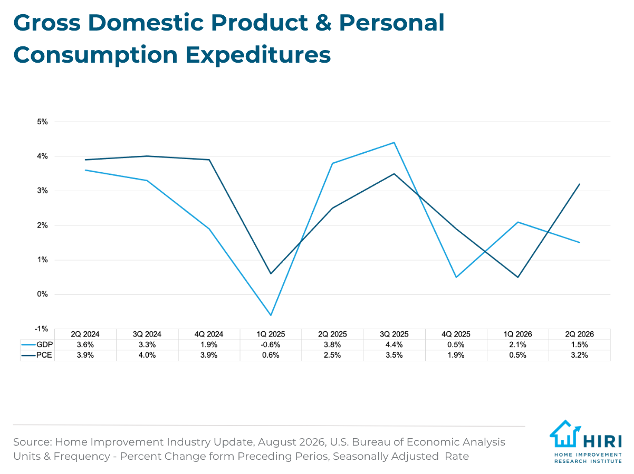
When an economy slows down but consumer spending speeds up at the same time, the spending is rarely coming from where you would expect, and HIRI's own homeowner data demonstrates where it may be coming from.
HIRI's Q2 2026 Homeowner Project Activity Tracker found average spend per project rose sharply that quarter, even as the share of homeowners completing any project at all fell to its lowest point since at least the second quarter of 2025. HIRI's analysis of how fewer active households are spending more covers this same dynamic across the broader market. For a manufacturer, that combination is a warning against treating the national spending number as a reason to expand marketing toward a broader group of homeowners. It is closer to a signal to spend more time and budget on the smaller group of homeowners who are still buying, since they now account for a larger share of every dollar moving through the category.
The tracker also found 37% of homeowners reporting their disposable income had worsened over the prior year, compared with 23% reporting an improvement, the widest gap since at least the second quarter of 2025. HIRI's recent look at homeowner spending readiness found the same split. Put together, a narrower, more financially stable group of households is carrying more of the category's growth, which argues for protecting and deepening relationships with your best existing customers this fall before chasing new ones.
A Labor Market Sending Mixed Signals
The U.S. economy lost 23,000 jobs in July 2026, reversing a gain of 20,000 jobs in June, while construction employment moved the opposite direction, adding 22,000 jobs that same month. A national labor market shrinking while its construction segment keeps hiring is really two separate questions for a manufacturer to ask, not one number to react to.
The first question is whether homeowners feel able to spend, and July's numbers answered it poorly. 41% of homeowners told HIRI that an increase in household income was the top reason they would start a project in the second quarter of 2026, a statistically significant jump from the first quarter, and the month after that survey closed, national payrolls moved the wrong way for that condition to be met. For manufacturers, that timing matters more than the headline jobs number does. The exact thing homeowners said they needed got worse the following month, not better.
The second question is whether the industry itself can staff the work, and that answer looks more reassuring. Construction hiring did not soften with the broader economy, which tells manufacturers the near term constraint is not on the supply side. Your channel is not short on installers right now, but it is short on homeowners who feel ready to spend.
Why Contractor Postponements Are Increasing
The combined share of contractors who postponed or cancelled a scheduled job climbed to 60% in the second quarter of 2026, up from 54% in the first quarter, the highest level since the second quarter of 2025.
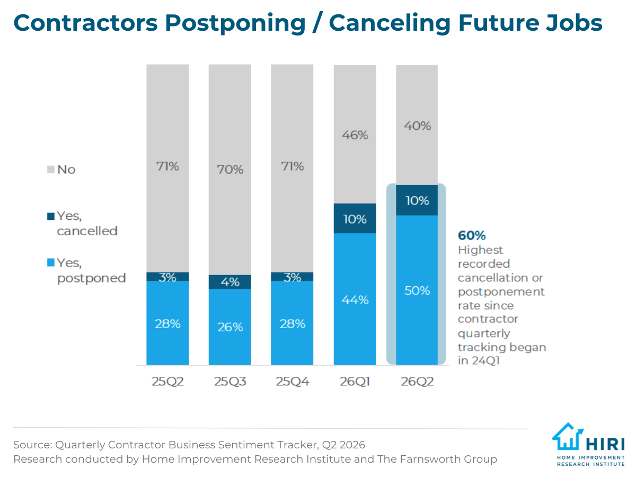
Six in ten contractors dealing with a postponed job in a single quarter is a number worth a manufacturer's attention on its own, but the more useful question for planning purposes is why it happened, not that it happened.
HIRI's Quarterly Contractor Business Sentiment Tracker asked contractors directly why jobs were postponed or cancelled, and the answer shifted meaningfully between quarters. Labor costs rose from 15% to 23% as a cited driver, the largest move of any reason tracked, while budget and financial reasons, the driver tied most closely to homeowner affordability, eased from 28% to 23%. That reversal points manufacturers toward a different fix than the one most brands default to, since a product that saves a contractor an hour on install addresses a labor cost problem in a way a homeowner discount does not.
Construction employers added 22,000 jobs in July 2026, up from 5,000 in June, which helps explain where the labor cost pressure described above is coming from. An industry adding jobs and posting more openings is also an industry competing harder for workers, and HIRI's analysis of budget uncertainty versus lack of demand found the same pattern earlier this year. For manufacturers, faster install products, simplified specification, and reliable lead times address this specific friction, in a way pricing and promotions aimed at homeowners do not.
The Real Problem Is Fewer Leads, Not Fewer Closes
Contractors bid on an average of 13.7 projects in the second quarter of 2026, down from 15.0 in the first quarter, even as the share of bids that converted into awarded work held roughly steady near 74%. For a manufacturer, the falling bid count matters more here than the steady conversion rate does. Fewer new leads are reaching contractors in the first place, which means the opportunity you are missing is not happening at the closing table. It is happening before a homeowner ever picks up the phone.
That matches what homeowners reported over the same stretch. The share of homeowners with no home improvement project planned for the next 12 months climbed to 28% in the second quarter, at least the fourth consecutive quarterly rise, while the Conference Board's Consumer Confidence Index fell 1.5% in July from its June reading. Two different surveys of two different groups are describing the same narrowing funnel from opposite ends, which is a stronger signal than either one would be alone.
The work that did continue leaned toward necessity. Kitchen work fell from 51% to 47% of contractor activity between the first and second quarters, while exterior work, more often repair and maintenance driven, held steady near 42% over the same stretch. For a manufacturer with a mixed portfolio, that split suggests discretionary categories are softening while more routine categories are holding up better, worth factoring into fall product mix planning.
Why Pros are Getting Fewer Home Improvement Project Requests
Contractors and homeowners actually share the same top concern. The economy ranked first for both groups in the second quarter, named by 57% of homeowners and 56% of contractors, with inflation close behind for each. Where the two groups diverge is further down the list. 28% of contractors named housing affordability as a top concern that quarter, second only to the economy and inflation for that group, while just 14% of homeowners ranked it that high.
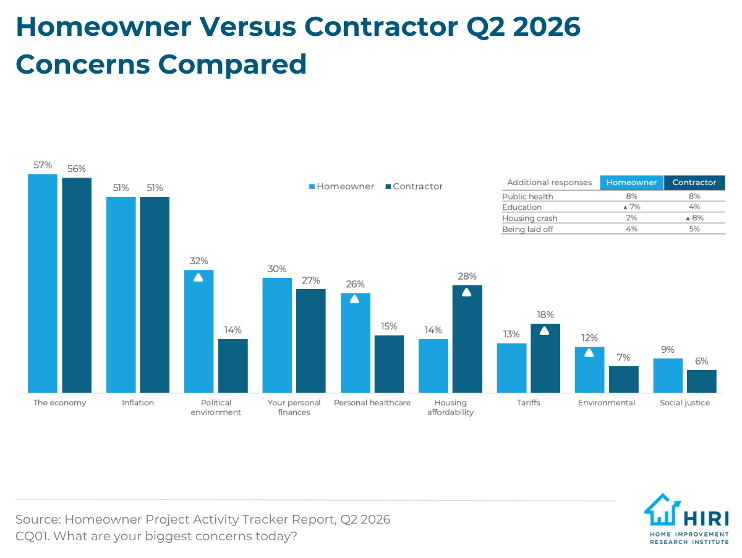
Contractors sit closer to the aggregate market than any single homeowner does, and if their read on affordability is right, the funnel above may have further to narrow before it levels off. Since conversion held steady while bid volume fell, the constraint sits upstream of the sales conversation, before a contractor is even asked to quote, which argues for shifting some marketing investment toward generating that first homeowner contact rather than toward closing tactics for deals already underway.
Why Remodeling Still Beats Moving
The 30-year mortgage rate held roughly steady at an elevated level in July 2026, only 0.2 percentage points below its level a year earlier, and home prices kept rising over the same 12 months. Neither number gives a homeowner much reason to sell, and that math has not changed in years.
HIRI's forecast work on the mortgage lock in effect explains why that incentive has held this long and is likely to persist, which remains the strongest structural argument manufacturers have for remodeling as a category right now.
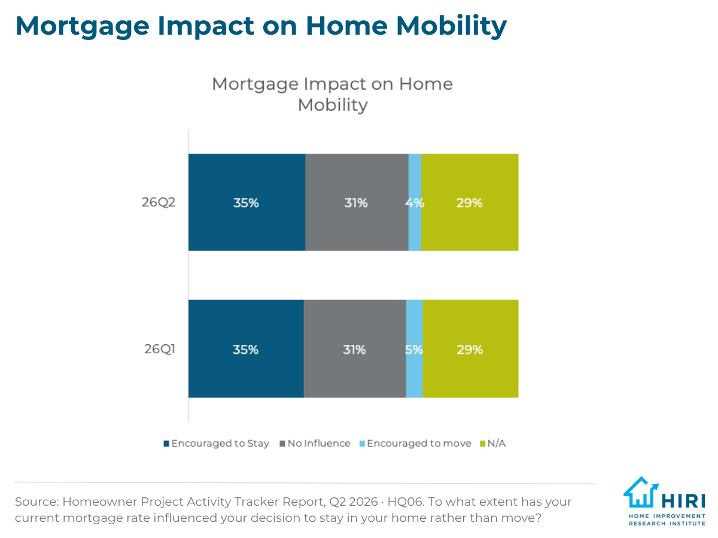
What changed this quarter is that homeowners grew more cautious anyway. HIRI's Q2 2026 tracker found confidence turned negative for the first time in the smallest, most routine project tier, even as real activity in that tier continued largely unchanged. Confidence and behavior moved in different directions, which tells manufacturers this looks more like a confidence problem than a structural one.
That combination, a durable incentive to stay paired with rising short term hesitation, argues for treating this quarter as a dip to manage through rather than a reason to pull back on longer range product or channel investment built around remodeling over moving.
What the Slowdown Means for 2027
Retail sales at building materials, garden equipment, and supplies dealers fell 1.2% in June 2026 from May, but stayed 6.9% above June 2025. A single softer month is easy for a manufacturer to overreact to, and this one has not yet broken the longer trend behind HIRI's own forecast that the total home improvement products market will grow 2.6% in 2026. HIRI's own look at where the industry stood earlier this year found the same moderate, real growth alongside the same persistent caution described throughout this piece.
The more useful discipline for manufacturers planning for 2027 is not reacting to any single data point, but watching whether the gap this piece has traced repeatedly, between homeowners moving toward a decision and homeowners planning nothing at all, continues to widen or begins to close. That gap, more than any single monthly figure, is the number worth building your next planning cycle around.
Using Data to Get the Real Story on Market Growth for Home Improvement
HIRI publishes its Homeowner Project Activity Tracker and Contractor Business Sentiment Tracker every quarter, and curates a monthly Economic and Industry Update every drawing on sources including the Bureau of Economic Analysis, the Bureau of Labor Statistics, the Census Bureau, Freddie Mac, and NAHB, among others. As a HIRI member, you have access to the full reports behind every figure in this piece, along with the analysis our research team provides to help you apply the data to your own strategy. HIRI's quarterly market update webinar walks through these same findings live each quarter for members who prefer a guided briefing.

HIRI members gain access to over $1 million worth of home improvement market research and industry analysis annually, as well as expert insights. Additionally, our team is here to help support you in utilizing HIRI research to make strategic decisions within your organization. Not yet a HIRI member? Schedule a consultation with Dave King to discuss specific ways HIRI's research would help you.

FAQs
Did the US job market add or lose jobs in July 2026?
According to the U.S. Bureau of Labor Statistics, as reported in HIRI's Economic and Industry Update Report for August 2026, the US economy lost 23,000 jobs in July 2026, a reversal from a gain of 20,000 jobs in June 2026. The unemployment rate held roughly steady at 4.1%. Construction employment moved in the opposite direction, with construction employers adding 22,000 jobs in July 2026 and the construction unemployment rate falling to 3.7%.
Are contractors seeing fewer or more home improvement jobs in 2026?
Fewer, in the second quarter of 2026. The Home Improvement Research Institute's Quarterly Contractor Business Sentiment Tracker found contractors bid on an average of 13.7 projects that quarter, down from 15.0 in the first quarter, and the combined share of contractors who postponed or cancelled a scheduled job climbed to 60%, the highest level since the second quarter of 2025. When asked why, contractors pointed to labor costs more than to homeowner budget constraints. That matches HIRI's Q2 2026 Homeowner Project Activity Tracker, which found the share of homeowners with no project planned for the next 12 months rose to 28% that same quarter, the fourth consecutive quarterly increase.
Why are contractors more concerned about housing affordability than homeowners are?
Contractors see a wider slice of the market than any single homeowner does. The Home Improvement Research Institute's Quarterly Contractor Business Sentiment Tracker found 28% of contractors named housing affordability as a top concern in the second quarter of 2026, compared with 14% of homeowners in HIRI's Q2 2026 Homeowner Project Activity Tracker. That gap may reflect contractors watching affordability pressure shrink their overall pool of potential customers, rather than reporting on their own household budget the way a homeowner respondent would.
Are mortgage rates making it more attractive to move instead of remodel?
Not based on the latest data. Freddie Mac data reported in HIRI's Economic and Industry Update Report for August 2026 showed the 30-year mortgage rate held steady in July 2026 and remained only 0.2 percentage points below its level a year earlier, while home prices continued to rise. Elevated rates and climbing prices continue to make staying in place and remodeling more attractive than moving for many homeowners.