
Gain insight into homeowners’ attitudes and motivations driving home improvement initiatives.
Edit
Home Improvement News
Current Home Improvement Project Activity Trends
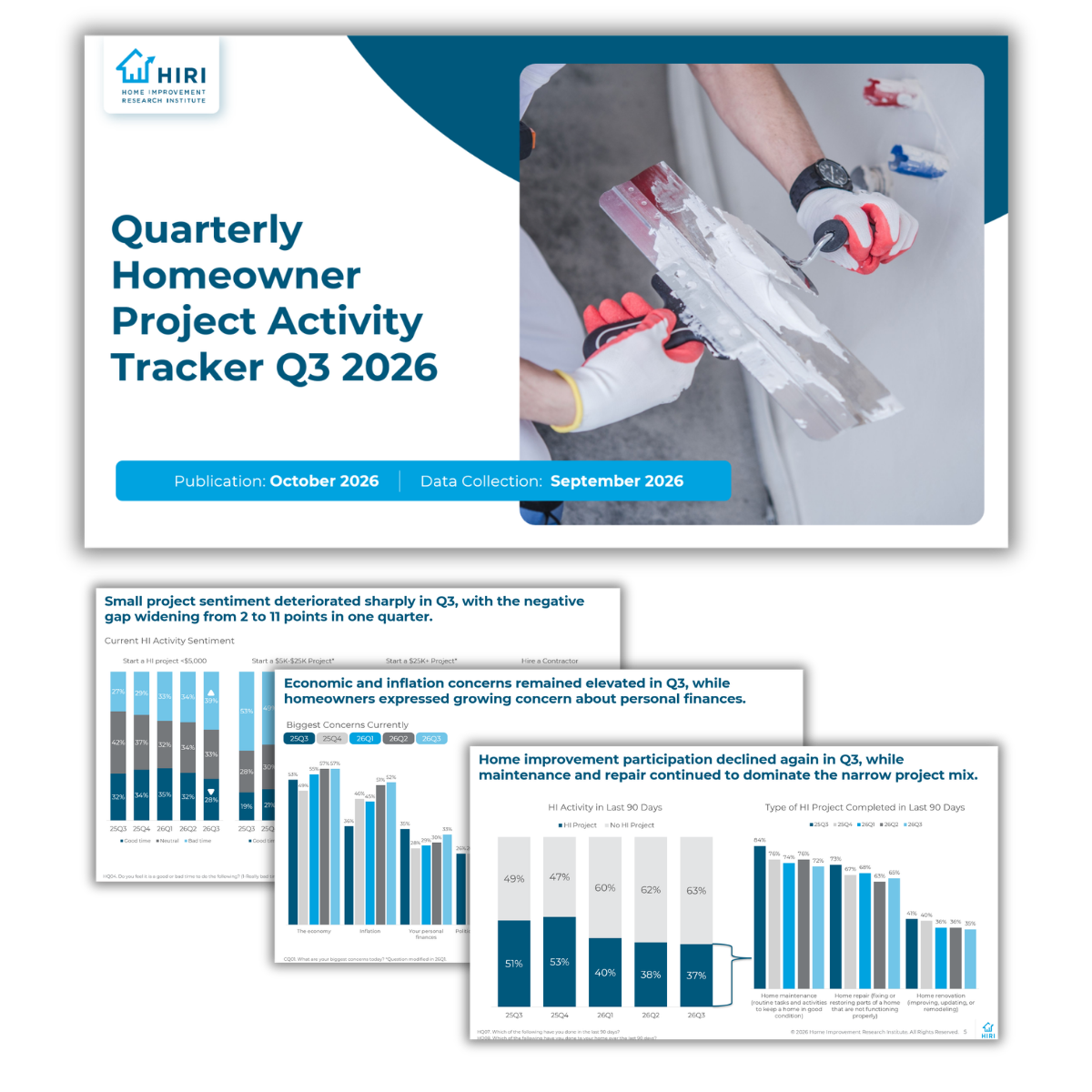
Understanding the dynamic landscape of home improvement is crucial for businesses and researchers alike. This study aims to gain insight into homeowners’ attitudes and motivations driving home improvement initiatives, shedding light on the recent activities they have undertaken within the last 90 days and planned activities in the next 90 days. You will see detail on project activity by areas of the home, product categories purchased, where products were purchased and more.
Objectives
Investigation of recent home improvement activities conducted within the last 90 days.
Analyze evolving channel behaviors over time in home improvement practices.
Delve into research patterns and influential factors shaping project and product purchasing decisions.
Understand the reasons why homeowners did not undertake home improvement activities in the last 90 days.
Anticipate future home improvement endeavors by understanding homeowners’ project intentions.
FAQs
High-Impact Market Research
Access research that covers consumer behaviors, industry trends, channel shifts, and purchasing patterns. Our data is designed to help you understand the "why" behind industry changes, not just the "what."
Actionable Insights
Access research that covers consumer behaviors, industry trends, channel shifts, and purchasing patterns. Our data is designed to help you understand the "why" behind industry changes, not just the "what."
Actionable Insights
Access research that covers consumer behaviors, industry trends, channel shifts, and purchasing patterns. Our data is designed to help you understand the "why" behind industry changes, not just the "what."
Actionable Insights
Access research that covers consumer behaviors, industry trends, channel shifts, and purchasing patterns. Our data is designed to help you understand the "why" behind industry changes, not just the "what."
High-Impact Market Research
Access research that covers consumer behaviors, industry trends, channel shifts, and purchasing patterns. Our data is designed to help you understand the "why" behind industry changes, not just the "what."
Actionable Insights
Access research that covers consumer behaviors, industry trends, channel shifts, and purchasing patterns. Our data is designed to help you understand the "why" behind industry changes, not just the "what."
FAQs
What are some popular home improvement projects people are doing themselves instead of hiring professionals?
Some of the most popular projects that people are doing themselves, rather than hiring professionals for the work, include interior painting, gardening and landscaping, and small repairs and maintenance. On the flip side, homeowners are more likely to hire a professional for complex projects that require specialized training, certifications, or tools and equipment, such as HVAC, major plumbing projects, electrical work, and roofing. The Home Improvement Research Institute's Quarterly Homeowner Project Activity Tracker offers insight into current DIY trends, including the percentage of homeowners who are using that approach versus hiring a contractor or, as is becoming more common, combining DIY with professional assistance. Additionally, HIRI's biennial Project Decision Study covers five key project areas (Exterior Envelope, Interior Finish, Major Renovations, Mechanical Systems, and Yard, Garden and Outdoors) and includes data on the percentage of homeowners who choose DIY for projects within those various categories.
What motivates people to choose DIY over hiring professionals for home projects?
Homeowners are motivated to choose DIY over hiring professionals for improvement projects for a variety of reasons. According to data in the Home Improvement Research Institute's Quarterly Homeowner Project Activity Tracker, the main reasons for using a DIY approach are "able to do the work myself," "cheaper if I did the work," "I enjoy the work," and "speed or convenience." Additionally, the average number of DIY hours has been decreasing slightly over the past couple of years, based on HIRI's Annual Home Improvement Project Activity Tracker. There are also generational differences. Gen Z completes the highest average of DIY hours, showing the strongest preference for this method over hiring professionals, followed by Millennials and Gen X, with a notable drop off of average DIY hours among Baby Boomers. Both of HIRI's homeowner trackers are useful resources for understanding why consumers choose DIY over hiring professionals (and vice versa) and how those motivations shift over time.
Which publications offer the best insights into the factors influencing DIY and DIFM choices?
The Home Improvement Research Institute (HIRI) offers several publications that offer insights into the factors influencing do-it-yourself (DIY) and do-it-for-me (DIFM) choices and trends. HIRI's Quarterly Homeowner Project Activity Tracker measures not only recent home improvement project activity, but also the completion methods used and the motivations behind them. This publication gives a regularly updated overview of how home improvement projects were completed in the most recent quarter, the reasons for completing DIY, and the reasons for DIFM, or for hiring a professional. It also examines how homeowners primarily find the professionals they're hiring for jobs. HIRI's Annual Home Improvement Project Activity Tracker and biennial Project Decision Study also offer some of the best insights into DIY and DIFM trends, with the latter providing deeper insights into completion methods based on specific project categories.
What does the Home Improvement Research Institute say about consumer preferences for DIY versus DIFM?
Over the past year, there's been a shift from using a purely DIY approach to implementing a hybrid method that incorporates some assistance from professionals to help manage cost, complexity, and execution, based on findings from the Home Improvement Research Institute's Quarterly Homeowner Project Activity Tracker. The percentage of homeowners used both DIY and a contractor jumped to 46% in Q1 2026, compared to 23% in Q1 2025. When it comes to consumer preferences for DIY versus DIFM, the desire for a contractor centers on technical expertise, followed by work quality, project complexity, guaranteed workmanship, and specialized tools and equipment. In 2026, contractor mix remains stable, with generalists and core trades leading, while satisfaction stays consistently high across project types, according to HIRI's research.
What are the latest statistics on consumer spending in home improvement?
Based on findings from the Home Improvement Research Institute's Q1 2026 Quarterly Homeowner Project Activity Tracker, about 29% of consumers plan to spend more on home improvement in the next 12 months, while 42% plan to spend the same and 29% plan to spend less. Smaller projects (in the $5k and under range) maintain appeal, while sentiment toward larger projects and contractor hiring remains subdued. According to the tracker, economic and personal financial pressures weigh on home improvement decisions, while mortgage rates continue to anchor owners in place. Home improvement spending is concentrated in major renovations and systems, while exterior and outdoor projects reflect more moderate investment levels. However, spending is rising among homeowners who are actively pursuing projects, while financing shifts beyond cash, reflecting greater reliance on credit amid fewer, selective projects. HIRI's Quarterly Homeowner Project Activity Tracker, along with HIRI's Annual Home Improvement Project Activity Tracker, is a useful resource for getting the latest statistics on consumer spending in home improvement, along with data on several other trends related to market conditions, product-purchasing behaviors, and future project intent.
Edit
Related Reports
Not a Member Yet?
Explore free articles, infographics, and webinars to get even more value from HIRI
Infographic
Key Homeowner and Contractor Trends in Q1 2026
Home improvement activity has been off to a slower start in 2026, with...
Infographic
What’s Driving Home Improvement Spending in 2026?
Despite a continued level of financial strain and tempered customer co...
Webinar
HIRI Home Improvement Industry & Recent Research Update - November 2026
Join HIRI Executive Director Dave King for a timely update on the late...
Fast Fact
Homeowners who finance spend nearly 3 times more per project than those who don't, $12,500 versus $4,250, despite having lower net worth.
Financed and non-financed homeowners report the same median household ...

Enter a valid email address
There was an error
Thanks for subscribing!
© 2026 Home Improvement Research Institute. All rights reserved.