
In 2026, dollar growth in the home improvement products market is hiding a real decline. While the market is projected to grow roughly 2.6% in current dollars, it is actually contracting by about -1.4% when taking into account inflation.
In short, the industry is facing a price-inflated, not a demand-growth, market. If building products brands are experiencing flat dollar sales this year, it’s likely that unit volume is actually down.
While real growth is expected to return in coming years and hold at nearly 2.2% through 2030, the timing remains conditional, based on the Home Improvement Research Institute’s Quarterly U.S. Size of the Home Improvement Products Market Forecast. That doesn’t mean growth is out of the question still in 2026. It’s possible to expand market share, even when demand isn’t growing, but in today’s flat market, that growth must come from moving stalled projects forward and capturing share from competitors. Both are within the reach of building products manufacturers and retailers.
During The North American Hardware and Paint Association's 2026 Independent Home Improvement Conference, HIRI's Executive Director Dave King dove into the effect that macroeconomic dynamics are currently having on building products companies. He also explained why execution matters more than macroeconomic conditions and outlined strategies that brands can employ without waiting for market conditions to improve.
What Macroeconomic Conditions are Dragging Down Growth in 2026?
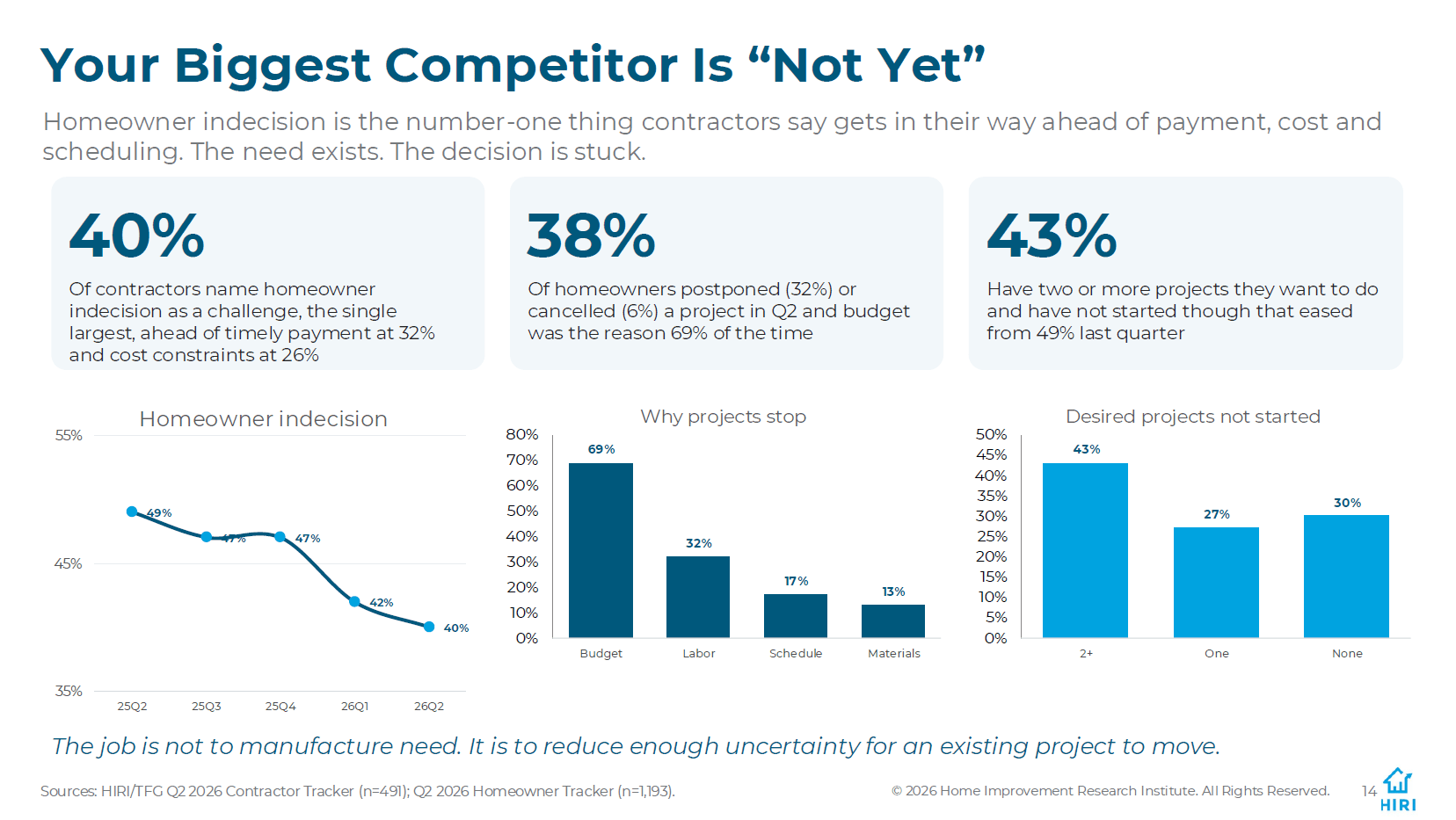
Right now, homeowner indecision is the number one thing contractors say gets in their way of project progression, ahead of payment, cost, and scheduling. It affected roughly 40% of contractors in Q2 2026, based on findings from HIRI’s Quarterly Contractor Business Sentiment Tracker. Homeowners are also postponing and canceling projects at an increasing rate, with roughly two-thirds citing budget concerns as the reason. They are feeling pressure from inflation, high mortgage rates, increased materials costs, and the overall state of the economy, which is causing uncertainty and decreasing their confidence. That doesn’t negate that demand exists.
According to HIRI’s Quarterly Homeowner Project Activity Tracker for Q2 2026, about 43% of homeowners have two or more projects they want to do and haven’t started. Their general attitude is “not yet,” as they wait for a better outlook, and that’s where building products companies can step in with strategies tailored to the demand that still exists.
Winning Market Share When Demand Is Softer
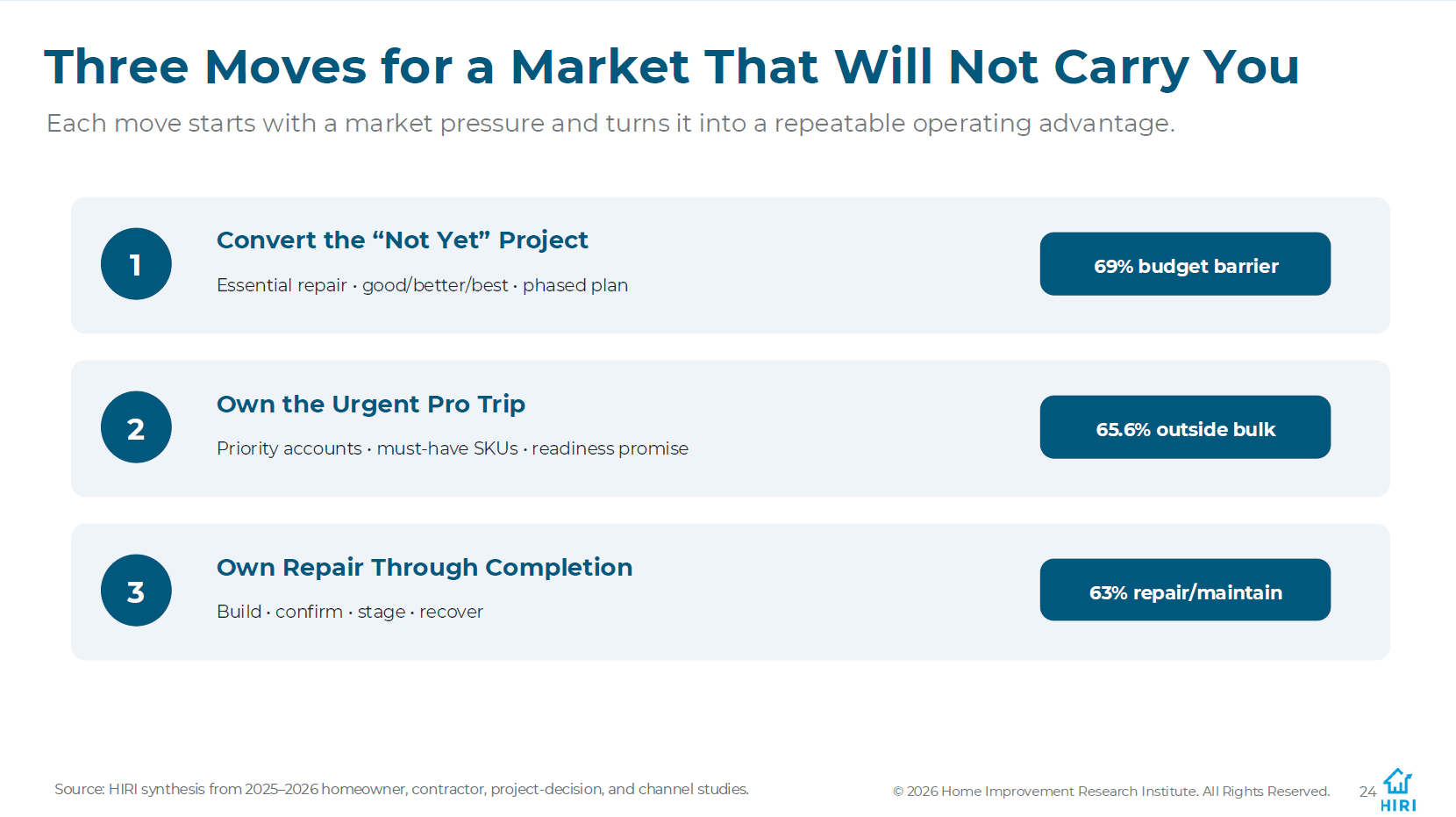
The difference between outperformers and average performers comes from execution, not simply better market conditions. In his presentation, Dave explored three strategic moves that brands can employ, each of which addresses a key market pressure.
1. Convert the “Not Yet” Project
Budget is a barrier for about 69% of projects, making it more than twice the next-largest challenge that leads to delays. At the same time, about 73% of contractors at least sometimes receive requests for a scaled-down quote, according to findings from HIRI’s Quarterly Contractor Business Sentiment Tracker. Building products brands can address this issue, and capture the pause, by giving customers a credible way to begin. That includes:
- Focus on Essential Repair: Solve the most pressing issue, which is maintenance and repair to prevent failure and mitigate long-term risk.
- Offer Good/Better/Best Options: Since customers are often interested in scaling back the scope of their project or choosing less expensive products to manage budget concerns, make trade-offs in your product lines visible and complete.
- Encourage Phased Planning: Support customers in addressing the most urgent portion of their planned project, not making it an all-or-nothing scenario, and save the next step for when their confidence has increased.
You can measure the success of these steps through tracking quote-to-start conversations, the number of projects reactivated, and completed-project units per transaction.
2. Own the Urgent Pro Trip
An inflation-adjusted look at the home improvement products market for 2026 shows the professional segment contracting significantly more than the consumer segment, or -3.4% to -0.1%, respectively. It’s important for building products companies to provide professional customers with support, engagement, and quality service.
In today’s market, though, to see the greatest returns, you have to concentrate your high-touch service to where potential, fit, and job-flow value are the strongest. Here’s how to begin that process:
- Identify Your Top Pro Accounts: Rank them by potential, gross profit, and profit fit so you can identify your priority accounts and where to direct your focus.
- Pinpoint Must-Have SKUs: Identify your top 100 (or so) SKUs and be prepared to frequently audit fill, address recurring misses, and come up with readily available alternatives to keep sales moving.
- Offer a Readiness Promise: When it comes to your priority professional accounts, develop a high standard of readiness and response. Know the name of the owner, establish a will-call standard, and be poised with fast recovery when issues arise.
- Integrate a Referral Loop: Connect trusted customers and qualified professionals to build up the industry as a whole and keep projects moving along.
A few of the measurements of success you should track include priority-pro fill rates, purchase frequency, and gross-profit dollars.
3. Own Repair Through Completion
About two-thirds of the project activity being completed right now is repairs and maintenance, based on findings in HIRI’s Quarterly Homeowner Project Activity Tracker for Q2 2026. It’s important to tap into that available demand and support customers through to the completion of their project. Sell the complete outcome by taking these steps:
- Build a complete list of products needed for a project, along with approved alternatives.
- Confirm the compatibility of products, and do so without making crews wait, thereby delaying the project.
- Stage appropriately, offering pick-up or delivery options that are aligned to the job.
- Recover the positive benefits, engaging proactively with the named owner of the project and offering fast resolution for any concerns or holdups.
You can get the edge in the repairs and maintenance market by preventing second trips to the store, ensuring customers aren’t given the wrong part, and inadvertently stalling crews and overall project progress. To measure outcomes, track complete-order readiness, returns and callbacks, and recovery time.
Taking Action to Recalibrate in 2026
Although planned spending went net-negative in the second quarter of 2026 and consumers are highly cautious, this is a confidence recession, not a demand collapse. The industry has been in this situation before, and each decline was followed by a recovery. Rather than retreat, building products brands should focus on recalibrating and moving stalled projects from waiting to working, seeing them through to completion. For detailed data and actionable insights to support your strategic business planning, sign up to become a HIRI member.
As a nonprofit research cooperative, HIRI offers an affordable, industry-focused research platform to help businesses in the home improvement sector make smarter, more informed decisions. By joining HIRI, you gain access to a treasure trove of data from one of the most trusted sources in the industry, all while helping shape the future of home improvement.

FAQs
How can building product manufacturers grow during a slow home improvement market?
Building product manufacturers can continue growing during slower markets by helping retailers improve project conversion, supporting contractor productivity, strengthening merchandising, improving product availability, and making it easier for homeowners to complete projects. According to the Home Improvement Research Institute's Quarterly Homeowner Project Activity Tracker for Q2 2026, about 43% of homeowners have two or more projects they want to do and haven’t started. Their general attitude is “not yet,” as they wait for a better outlook, and that’s where building products companies can step in with strategies tailored to the demand that still exists. Companies focused on execution often outperform those waiting for stronger economic conditions.
Why are contractor relationships increasingly important for building product manufacturers?
Contractors continue to influence a significant share of building product purchases, particularly within repair and maintenance categories. The Home Improvement Research Institute's Quarterly Homeowner Project Activity Tracker shows that more than 60% of home improvement projects are completed either by hiring a contractor or by using a hybrid method that incorporates DIY labor and help from professionals. Supporting contractors with product availability, technical resources, reliable fulfillment, and jobsite solutions helps manufacturers strengthen channel relationships while increasing product specification and repeat purchasing.
Why is operational execution becoming a competitive advantage in the building products industry?
When overall market demand slows, as is happening in 2026, companies compete more through execution than expansion. Data analysis from the Home Improvement Research Institute suggests that manufacturers and retailers who improve project readiness, inventory reliability, fulfillment, customer expertise, and contractor support are better positioned to gain market share because they help customers successfully complete projects rather than simply sell products. These operational advantages become increasingly valuable during periods of slower market growth.