
Mechanical, electrical and plumbing (MEP) projects tend to happen under the surface and behind the wall, but they're critical to maintaining the functionality and comfort of a home. With an aging housing inventory, these types of projects will be as important as ever in the coming years.
While MEP activities mirror other home improvement projects in several ways how and where materials are purchased and who's doing the shopping there are a few notable distinctions. For example, these projects require more specialty work, which tends to motivate homeowners to seek out consultation and assistance from professionals rather than going the DIY route or relying on amateur assistance from friends and family.
Taking note of these types of trends and activities within the MEP industry can help both manufacturers and suppliers make strategic decisions around product development, marketing, and prioritizing the channels that homeowners and contractors utilize when selecting and purchasing mechanical, electrical and plumbing products and materials.
What Trends are Affecting the Future of the MEP Industry?
The types of projects being completed by owners is not the only factor that drives product sales for the MEP industry. They're also influenced by the customer's motivations for undertaking the project, who's doing the purchasing (homeowners versus pros), and various other factors.
Forecast for Mechanical, Electrical and Plumbing Products Market in the U.S.
After spending in the building products market slowed in 2025, the entire home improvement industry has returned to a much steadier rate of growth for the next forecast period, from 2026 to 2030, and the MEP industry is no exception. The market for plumbing supplies is projected to have a compound annual growth rate (CAGR) of 3% during the forecast period, while the market for electrical supplies is expected to grow by 2.5%, according to HIRI’s quarterly U.S. Size of the Home Improvement Products Market Study.
The growth rate in the consumer segment of the building products market is projected to be 2.3% for electrical supplies and 2.9% for plumbing supplies from 2026 to 2030. The professional segment has a similar trajectory for the forecast period, with an anticipated CAGR of 2.3% for both electrical supplies and plumbing supplies. Products for MEP projects are not among the most purchased home improvement projects, but there is steady demand. Based on research in HIRI’s 2025 U.S. Homeowner Project Activity Report, the percentage of homeowners who had purchased from these product categories in the past 90 days was:
- Finished plumbing (14%)
- Finished electrical/lighting (10%)
- Rough-in plumbing (8%)
- Rough-in electrical (6%)
How Much Do Homeowners Spend on MEP Projects?
Spending for mechanical and systems improvements tend to be higher than most other categories, except for major renovations. HIRI’s Homeowner Project Activity Tracker Report for Q1 2026 showed the average spending for homeowners on mechanical/systems projects was $1,230. Further, HIRI’s Project Decision Study for mid-to-large systems projects found that project budgets for mechanical systems fell into these ranges:
- $5k to $9.9k (46%)
- $10k to $24.9k (42%)
- $25k to $49.9k (9%)
- $50k-plus (3%)
Note that HIRI's 2025 Project Decision Study narrows in on projects that cost $5k or more.
Project budgets for electrical and energy management systems fell into these ranges:
- $5k to $9.9k (60%)
- $10k to $24.9k (35%)
- $25k to $49.9k (5%)
The average amount that homeowners spent on these types of projects in 2025 was between roughly $7,000 and upwards of $18,000. HIRI members can see a breakdown of spending in each of the five categories in the study.
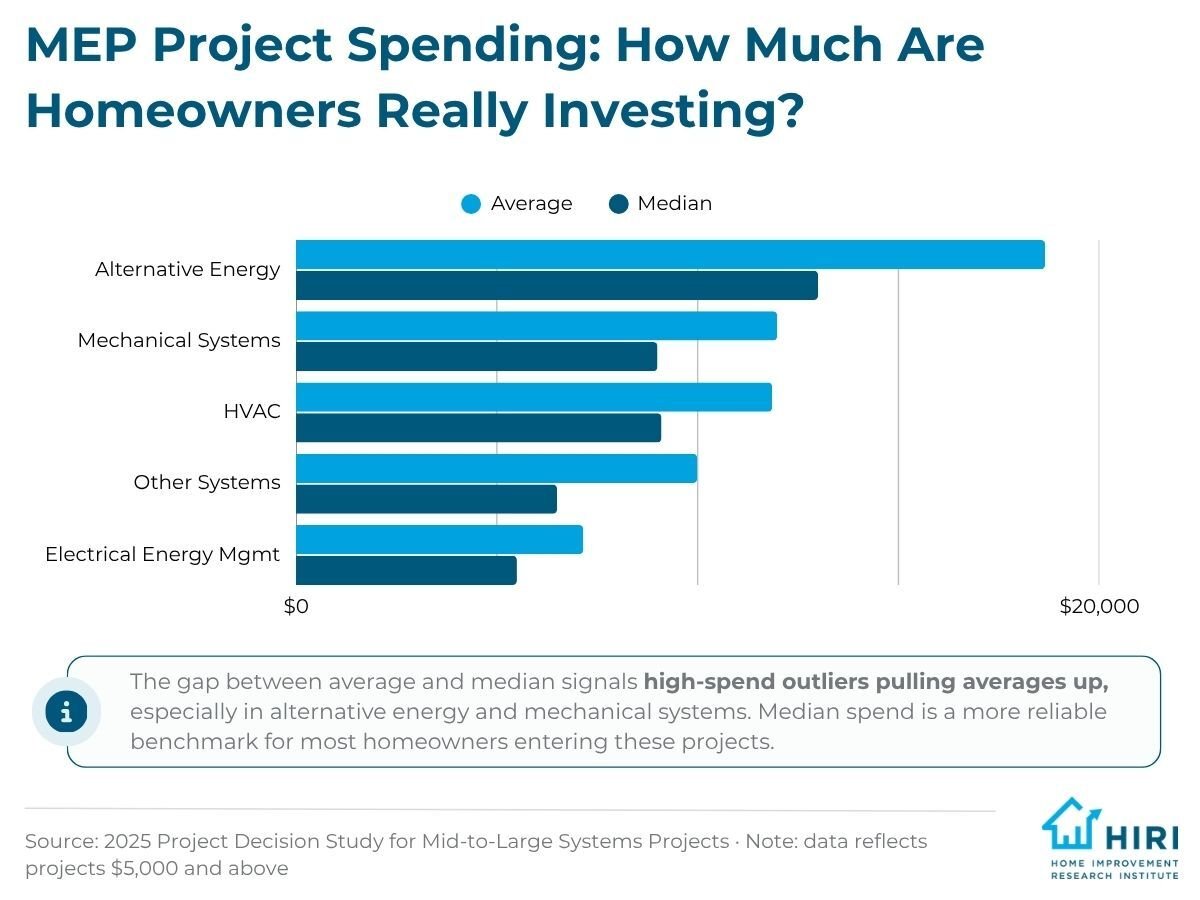
Mechanical systems spending is relatively isolated, with minimal overlap into building materials, interior finishes, or tools categories. The products typically purchased for these projects include:
- HVAC materials
- Rough-in electrical
- Rough-in plumbing
- Solar, generator or battery
- Home automation and security
Finished plumbing and finished electrical/lighting products are generally grouped under interior finish projects.
What are the Top Homeowner Motivations for MEP Projects?
HVAC is the most common mechanical project, while alternative energy carries the highest spending, based on HIRI’s Project Decision Study for mid-to-large systems projects. Other projects in these categories include:
- Electrical wiring
- Energy management
- Power generator
- Solar panels/storage
- Septic system
- Well
- Home automation/security
HIRI’s Project Decision Study for mid-to-large interior projects includes kitchen and bathroom renovations, which frequently incorporate plumbing and electrical elements.

Improving Energy Efficiency and Enhancing Safety and Security Drive MEP Projects
MEP projects vary from several other home improvement activities in that improving aesthetic/style and improving home value are not main considerations, whereas improving energy efficiency and enhancing safety and security are bigger drivers. For mechanical systems, the top project motivations are:
- Improve comfort/livability (50%)
- Energy efficiency (50%)
- Maintain/repair (45%)
For HVAC, the top project motivations are:
- Energy efficiency (53%)
- Improve comfort/livability (52%)
- Maintain/repair (48%)
For alternative energy, the top project motivations are:
- Energy efficiency (71%)
- Increase home value (55%)
- Improve comfort/livability (45%)
For electrical and energy management, the top project motivations are:
- Maintain/repair (56%)
- Safety and security (56%)
- Improve comfort/livability (47%)
Homeowners perceive alternative energy as offering the highest resale cost recovery, with HVAC and other systems viewed more modestly.
Influence of Professionals on MEP Projects
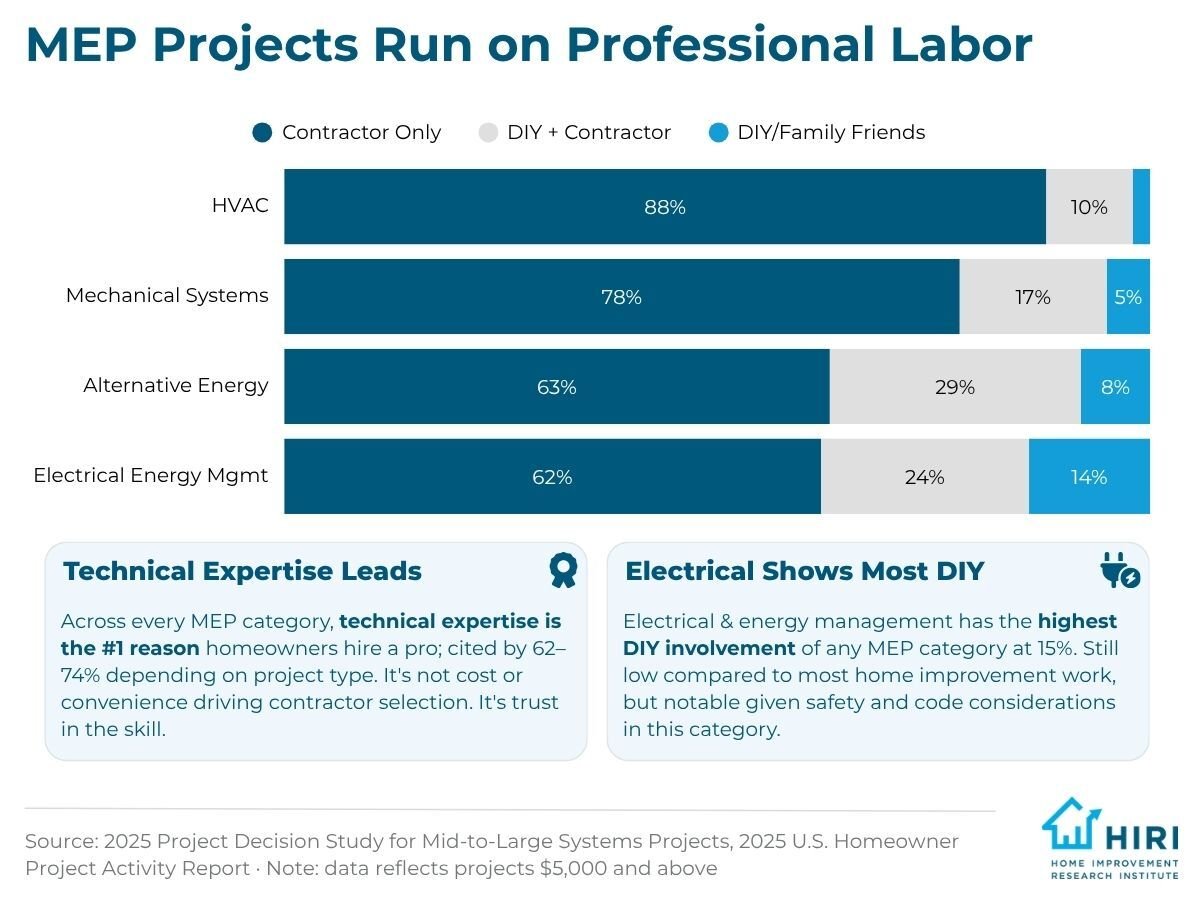
In general, homeowners are more likely to use contractors for mechanical, plumbing, and electrical work than to do the work themselves. However, electrical projects do show comparatively higher DIY involvement. Here is a closer look at the breakdown of DIY versus professional labor used for each project type.
Mechanical Systems Projects
- Contractor (78%)
- Both DIY and contractor (17%)
- DIY and/or family/friends (5%)
HVAC Projects
- Contractor (88%)
- Both DIY and contractor (10%)
- DIY and/or family/friends (3%)
Alternative Energy Projects
- Contractor (63%)
- Both DIY and contractor (29%)
- DIY and/or family/friends (8%)
Electrical/Energy Management Projects
- Contractor (62%)
- Both DIY and contractor (24%)
- DIY and/or family/friends (15%)
Be mindful that this data pertains to households who spent more than $5,000 on their projects, so these completion patterns reflect larger jobs, where professional labor is more common.
What are the Reasons for DIY or Hiring Pros for Mechanical Systems?
Based on findings in HIRI’s 2025 U.S. Homeowner Project Activity Report, the hiring of electricians and plumbers increased slightly compared to 2024. About 23% of homeowners hired a plumber, compared to 21% in 2024, and 15% hired an electrician, based on 10% in 2024. The motivations for using a DIY approach the mechanical projects mirror those for most home improvement projects. The main motivating factors are:
- Able to do the work myself (64%)
- I enjoy the work (64%)
- Cheaper if I did the work (58%)
- Wanted to ensure quality/workmanship (44%)
Meanwhile, the reasons for hiring pro vary slightly among different projects, although technical expertise is the top motivation for all. For mechanical systems projects, the top three reasons to hire a pro are:
- Technical expertise (72%)
- Work quality (58%)
- Specialized tools/equipment (57%)
For HVAC projects, the top reasons to hire a pro are:
- Technical expertise (73%)
- Work quality (58%)
- Guaranteed workmanship (56%)
- Specialized tools/equipment (56%)
For alternative energy, the top reasons to hire a pro are:
- Technical expertise (74%)
- Code compliance (63%)
- Specialized tools/equipment (63%)
- Work quality (60%)
For electrical and energy management, the top reasons to hire a pro are:
- Technical expertise (62%)
- Safety considerations (62%)
- Code compliance (55%)
Channels Used to Purchase MEP Products
Mechanical project materials often purchased by contractor, with sourcing more often direct for manufacturers. Contractors make a majority of purchases for:
- Alternative energy projects (61%)
- HVAC projects (59%)
- Mechanical systems (53%)
- Other systems (46%)
The one exception is for electrical and energy management projects. For that category, male heads of household make 44% of purchases, while contractors make 26%, and female heads of household make 18% of purchases. Big-box retailers are the most popular purchase channel for materials for mechanical systems and HVAC, although they are used at a lower percentage for these projects compared to other home improvement activities. Meanwhile, customers are more likely to use specialty suppliers and purchase direct from manufacturers for these products.
The main channels for purchasing mechanical systems products and materials include:
- Big-box retailers (51%)
- Specialty suppliers (33%)
- Direct from manufacturer (29%)
- Mass retailer (22%)
- Online-only retailer (19%)
- Local hardware store (19%)
- Lumber yard/building material dealer (13%)
- Warehouse club (10%)
The main channels for purchasing HVAC products and materials include:
- Big-box retailers (52%)
- Direct from manufacturer (27%)
- Specialty suppliers (24%)
- Mass retailer (21%)
- Warehouse club (15%)
- Online-only retailer (9%)
- Local hardware store (9%)
- Lumber yard/building material dealer (6%)

Popular Purchase and Delivery Methods for MEP Materials
Additionally, while shopping and picking up supplies in store is used for 59% of home improvement activities, this purchase and delivery method is only used for 44% of mechanical systems materials purchasing and 42% of HVAC materials purchasing. On the flip side, online purchasing with delivery is used for 35% of home improvement activities, in general, but it is used for 49% of mechanical systems products and 52% of HVAC products. Consumers are also much more likely to purchase additional tools for their projects. While the percentage of people who purchase tools for all home improvement activities is 25%, that percentage jumps to:
- 79% for mechanical systems
- 89% for HVAC
- 74% for alternative energy
- 66% for other systems
- 56% for electrical/energy management
Manufacturers can capitalize on these channel trends, working to connect directly with professionals and homeowners to market products in these categories. Your website should be up to date with product descriptions, pricing information, project cost estimates, budgeting tools, and other information that homeowners are searching for, so you can be top-of-mind when they decide to purchase products and materials for their electrical, mechanical or plumbing projects. Making sure that your products and materials are being promoted through your partners’ digital platforms is also important, since consumers are more likely to use this purchase and delivery method than they normally are.
Keeping Up with Trends for MEP Products and Materials
Product incidence rate. Project home characteristics. Project motivators and spending. Purchase behaviors among pros and DIY homeowners. These are just a few of the factors that change over time and will impact the decisions you make regarding your building products strategy. The Home Improvement Research Institute (HIRI) has the data you need. Members have access to a wide variety of research that digs deep into specific home improvement project types and product categories to give you the information you need to make informed decisions for your company. HIRI is a nonprofit, and functions similarly to a co-op, with member dues being pooled to fund approximately $1M of research annually, all for a nominal annual membership due. 
FAQs
What are the top mechanical home improvement projects this year?
HVAC maintenance and improvement is the most common mechanical project, while alternative energy carries the highest spending, based on HIRI’s Project Decision Study for mid-to-large systems projects. Other top mechanical home improvement projects include electrical wiring; energy management; power generator installation; solar panels/storage; septic system; well; and home automation/security.
Are more people choosing DIY or hiring professionals for plumbing projects?
In general, homeowners are more likely to use contractors for mechanical, plumbing, and electrical work than to do the work themselves. Based on findings in HIRI’s 2025 U.S. Homeowner Project Activity Report, the hiring of plumbers (and electricians) increased slightly compared to 2024. About 23% of homeowners hired a plumber, compared to 21% in 2024. The main motivating factors for hiring a pro for mechanical systems projects, including plumbing, include technical expertise (72%); work quality (58%); and specialized tools/equipment (57%).
What is the forecast for plumbing remodeling in residential homes?
Both the consumer and professional segments of the market for plumbing supplies are projected to have steady growth from 2026 to 2030, based on findings from the Home Improvement Research Institute’s quarterly U.S. Size of the Home Improvement Products Market Study. Additionally, HIRI’s 2025 U.S. Homeowner Project Activity Report found that 14% of homeowners had purchased finished plumbing products in 2025 and 8% had purchased rough-in plumbing supplies. Additionally, demand for kitchen and bathroom remodeling, which often include plumbing work, continues to be relatively high for 2026, according to HIRI’s quarterly Homeowner Project Activity Tracker.
How are market trends affecting electrical home repairs?
Home automation, implementing alternative energy sources, and enhancing energy efficiency are a few of the market trends affecting electrical home repairs. Alternative energy projects carry the highest average spending, based on HIRI’s Project Decision Study for mid-to-large systems projects. The integration of smart home devices is accelerating, and homeowners are also exploring the installation of solar panels, battery storage, and EV charging infrastructure. HIRI’s Government Incentives and Energy Retrofit Study provides more detail on the most common types of energy retrofit projects being completed and potential market opportunities tied to energy efficiency initiatives.