
Explore the impact of government incentives on homeowner and contractor decisions.
Edit
Edit
Retrofit Incentives
Government Incentives & Energy Retrofit Study
Government incentives and energy retrofit programs are becoming increasingly influential in shaping home improvement decisions. To better understand their role in driving energy-efficient upgrades, the Home Improvement Research Institute (HIRI) conducted this study examining how these programs affect both homeowners and contractors, as well as the broader market.
Objectives
Identify the most common types of energy retrofit projects being completed.
Assess awareness and utilization of available incentive programs.
Understand potential market opportunities tied to energy efficiency initiatives.
Past Iterations
FAQs
How do government incentives affect home improvement projects?
Government incentives exert broad sway on homeowner decisions to undertake various home improvement projects, though the degree of influence varies sharply. Younger, urban, and higher-income households are most responsive, while older, rural, and lower-income groups show muted reactions, according to data from the Home Improvement Research Institute's Government Incentives and Energy Retrofit Study. Incentives also resonate more with advanced DIYers, suggesting that capacity to execute projects shapes uptake. Gender differences are marginal, but age remains a decisive factor.
Overall, incentives amplify existing pragmatic drivers, chiefly cost and equipment replacement, highlighting their role as both catalyst and complement to underlying motivations. Homeowners face barriers to incentive participation, from cost and eligibility uncertainty to skepticism about credibility and effectiveness. Trust and affordability jointly define adoption challenges, with younger urban groups most confident and older rural homeowners more doubtful.
What impact do state incentives have on home improvement trends?
State incentives and energy retrofit programs are becoming increasingly influential in shaping home improvement decisions. Government incentives meaningfully influence retrofit adoption, which is strongest among younger, urban, higher-income, and advanced DIY households.
Older, rural, and lower-income groups remain less responsive, underscoring incentives’ role in amplifying pragmatic and cost-driven motivations, according to the Home Improvement Research Institute's Government Incentives and Energy Retrofit Study. Most homeowners can identify incentive eligible upgrades, but confusion persists with one in 10 misattributing ineligible projects.
Confusion spans generations, geographies, and skill levels, underscoring the breadth of the challenge. Knowledge gaps are particularly pronounced among lower-income, rural, and non-DIY households, while urban, affluent, and skilled DIY owners demonstrate stronger familiarity.
HIRI's study explores how government incentives and energy retrofit programs are becoming increasingly influential in shaping home improvement decisions. The data sheds light on how these programs affect both homeowners and contractors, as well as the broader market.
Do government incentives make home remodeling more affordable?
Government incentives can make home remodeling more affordable when they are utilized efficiently and accurately applied to eligible projects and products. However, homeowners face overlapping barriers that limit participation in incentive programs, based on data from the Home Improvement Research Institute's Government Incentives and Energy Retrofit Study.
Upfront cost is the most common obstacle, particularly for lower-income households, while uncertainty about eligibility and lack of awareness also weigh heavily. As income rises, financial barriers ease, but skepticism persists. Perceptions of effectiveness and credibility are strongly correlated, with younger and urban homeowners showing the greatest trust, while older and rural groups remain cautious.
Together, these findings highlight the dual challenge of affordability and trust in driving adoption.
What are the most popular government-funded home improvement projects?
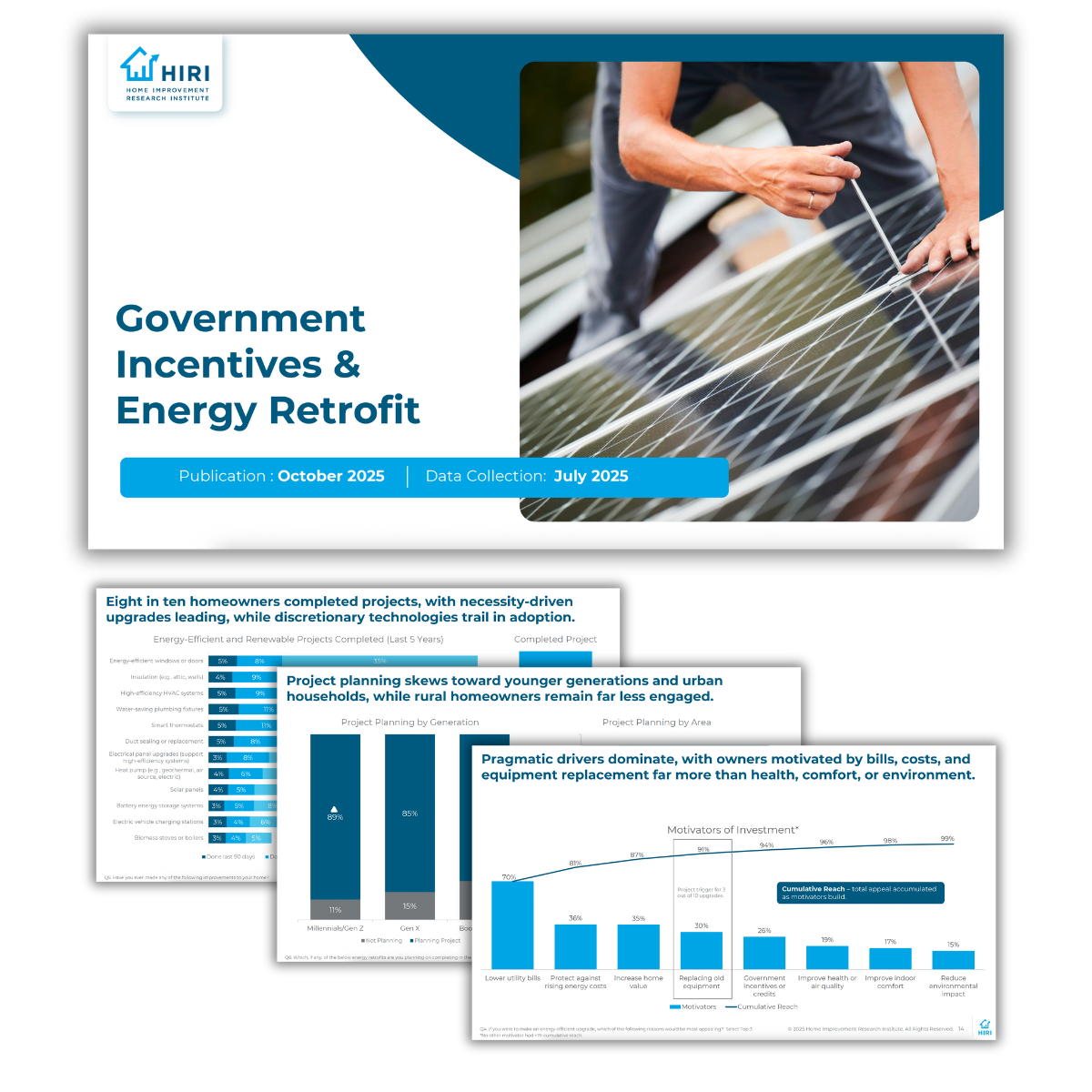
More than eight in 10 homeowners have undertaken energy efficient and renewable projects in the past five years, led by pragmatic, necessity-driven upgrades such as windows, insulation, and HVAC. Discretionary technologies like solar, storage, and EV charging lag considerably, based on findings in the Home Improvement Research Institute's Government Incentives and Energy Retrofit Study.
Adoption is influenced by capacity, with higher-income and younger households engaging more broadly, while older and lower-income groups defer. Rural households also trail urban peers. Looking forward, planned projects continue to center on pragmatic upgrades, with incentives emerging as a catalyst. Together, adoption reflects both practical necessity and aspirational potential.
Which home improvement products are most eligible for government incentives?
Some of the home improvement products that are most eligible for government incentives include solar panels; energy-efficient doors and windows; high-efficiency HVAC systems; smart thermostats; electric vehicle charging stations; insulation; water-saving plumbing fixtures; electrical panel upgrades; heat pumps; battery energy storage systems; and biomass stoves or boilers.
The Home Improvement Research Institute's Government Incentives and Energy Retrofit Study provides data to help identify the most common types of energy retrofit projects being completed and also assess awareness and utilization of available incentive programs. HIRI's research also highlights potential market opportunities tied to energy efficiency initiatives.
Do government incentives encourage more sustainable home renovations?
Government incentives encourage more sustainable home renovations, as well as energy efficient upgrades. The main reasons that homeowners are motivated to do these types of projects include lowering utility bills; protecting against rising energy costs; and increasing home value, based on the Home Improvement Research Institute's Government Incentives and Energy Retrofit Study.
Government incentives or credits are a project trigger for 3 out of 10 upgrades. Often, they have a cumulative effect on spurring more sustainable home renovations, along with other top drivers. Additionally, homeowners often view replacement as the moment to upgrade, with efficiency and renewable options seen as offering the best value.
HIRI's research provides detailed data about homeowners' awareness and understanding of government home improvement incentives and energy retrofit programs, and how government incentives influence their decisions to invest in sustainable and energy-efficient upgrades.
Edit
Related Reports
Not a Member Yet?
Explore free articles, infographics, and webinars to get even more value from HIRI
Infographic
Key Homeowner and Contractor Trends in Q1 2026
Home improvement activity has been off to a slower start in 2026, with...
Infographic
What’s Driving Home Improvement Spending in 2026?
Despite a continued level of financial strain and tempered customer co...
Webinar
HIRI Home Improvement Industry & Recent Research Update - November 2026
Join HIRI Executive Director Dave King for a timely update on the late...
Fast Fact
Homeowners who finance spend nearly 3 times more per project than those who don't, $12,500 versus $4,250, despite having lower net worth.
Financed and non-financed homeowners report the same median household ...

Enter a valid email address
There was an error
Thanks for subscribing!
© 2026 Home Improvement Research Institute. All rights reserved.