
If you are a home improvement manufacturer or retailer, understanding homeowners' behavior patterns and seasonal project trends can help you adjust your business strategy for success.
The Home Improvement Research Institute (HIRI) surveys homeowners quarterly to provide ongoing reporting and annual reviews of homeowner's current and planned improvement projects. We also analyze data from contractors to get an understanding of what types of home improvement activities property owners are hiring them to complete, along with their overall sentiments about the industry.
Collectively, this data creates a clear picture of home improvement project focus areas, homeowners' cost considerations, and other insights that can help manufacturers and suppliers develop effective business strategies for the year.
How is the Home Remodeling Market Expected to Change This Year?
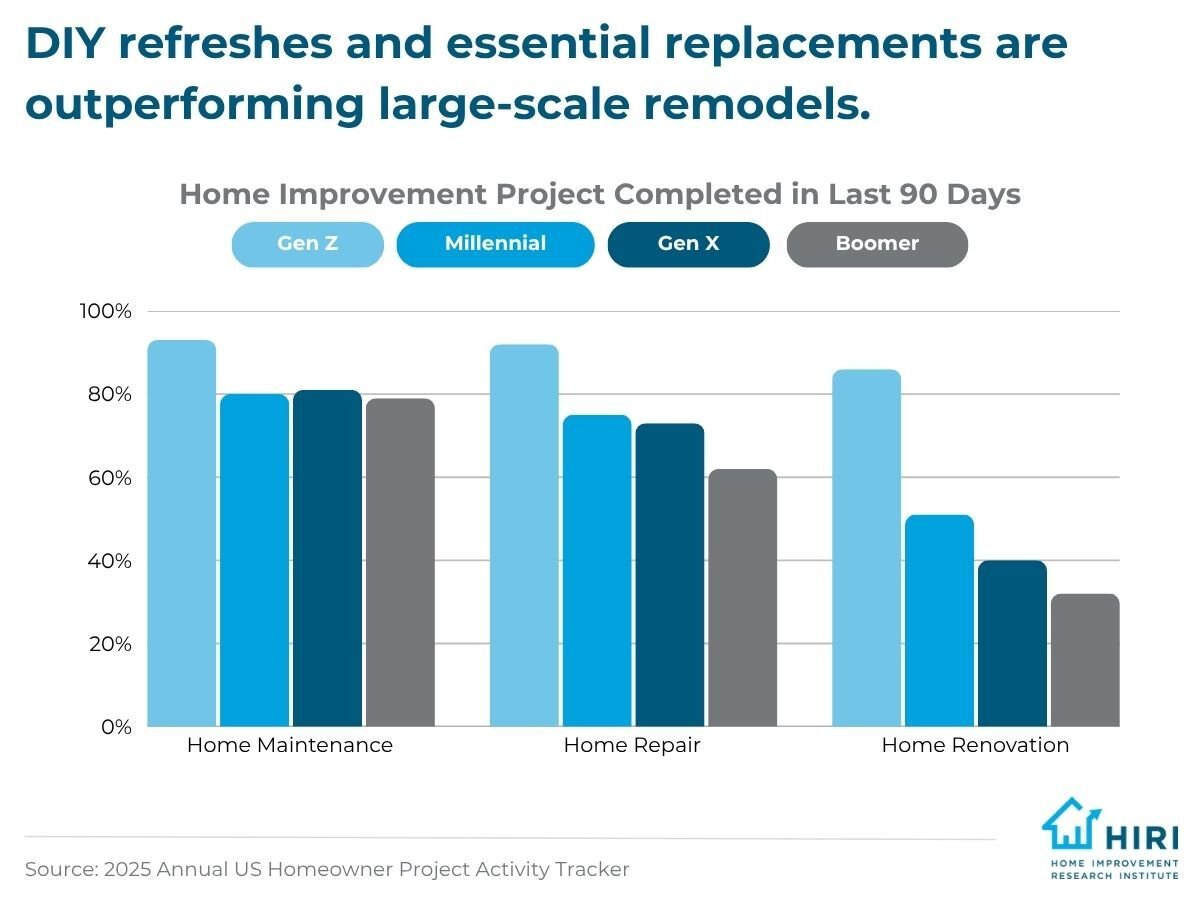
Inching up from 2024, nearly half of homeowners did a home improvement project in 2025. Younger generations led the way in most project categories, with marked difference in renovations, based on findings in HIRI’s 2025 U.S. Annual Homeowner Project Activity Tracker Report. Of the 48% of DIYers who completed home improvement projects in 2025, there are some interesting generational trends:
- DIY homeowners who completed maintenance projects in 2025 included:
- 93% of Gen Z
- 80% of Millennials
- 81% of Gen X
- 79% of Baby Boomers
- DIY homeowners who completed repair projects in 2025 included:
- 92% of Gen Z
- 75% of Millennials
- 73% of Gen X
- 62% of Baby Boomers
- DIY homeowners who completed renovation projects in 2025 included:
- 86% of Gen Z
- 51% of Millennials
- 40% of Gen X
- 32% of Baby Boomers
Looking ahead to how the remodeling market is expected to change this year, near-term project intention is on the rise, driven by maintenance and repairs. At the end of 2025, the types of projects that homeowners were planning to undertake in the next three months included:
- Home maintenance (50%, compared to 45% in 2024)
- Home repair (34%, compared to 30% in 2024)
- Home renovation (25%, same as 2024)
On average, homeowners planning to do some sort of home improvement activity in 2026 anticipated spending approximately $7,117 for projects.
What are Current Trends in Residential Home Remodeling?
While project activity remains stable in 2026, homeowners seem to be favoring smaller, necessary work, while only renovation-oriented households maintain stronger intent and broader improvement engagement. Looking at data from 2025 and what homeowners were intending to accomplish and spend in 2026 can give industry stakeholders insight into what to expect and how to strategize around the preferences, behaviors, and attitudes of DIY homeowners. Here are some of the current trends in residential home remodeling:
1. Outlook on Home Improvement Diverges by Orientation
When looking at homeowners and their home improvement intentions, there are four distinct homeowner orientations that emerge. Homeowners can be segmented into these categories:
- Content Homeowners (passive orientation): 29%
- Repair First Homeowners (problem-solving orientation): 18%
- Maintenance First Homeowners (stewardship orientation): 28%
- Renovation Ready Homeowners (proactive orientation): 25%
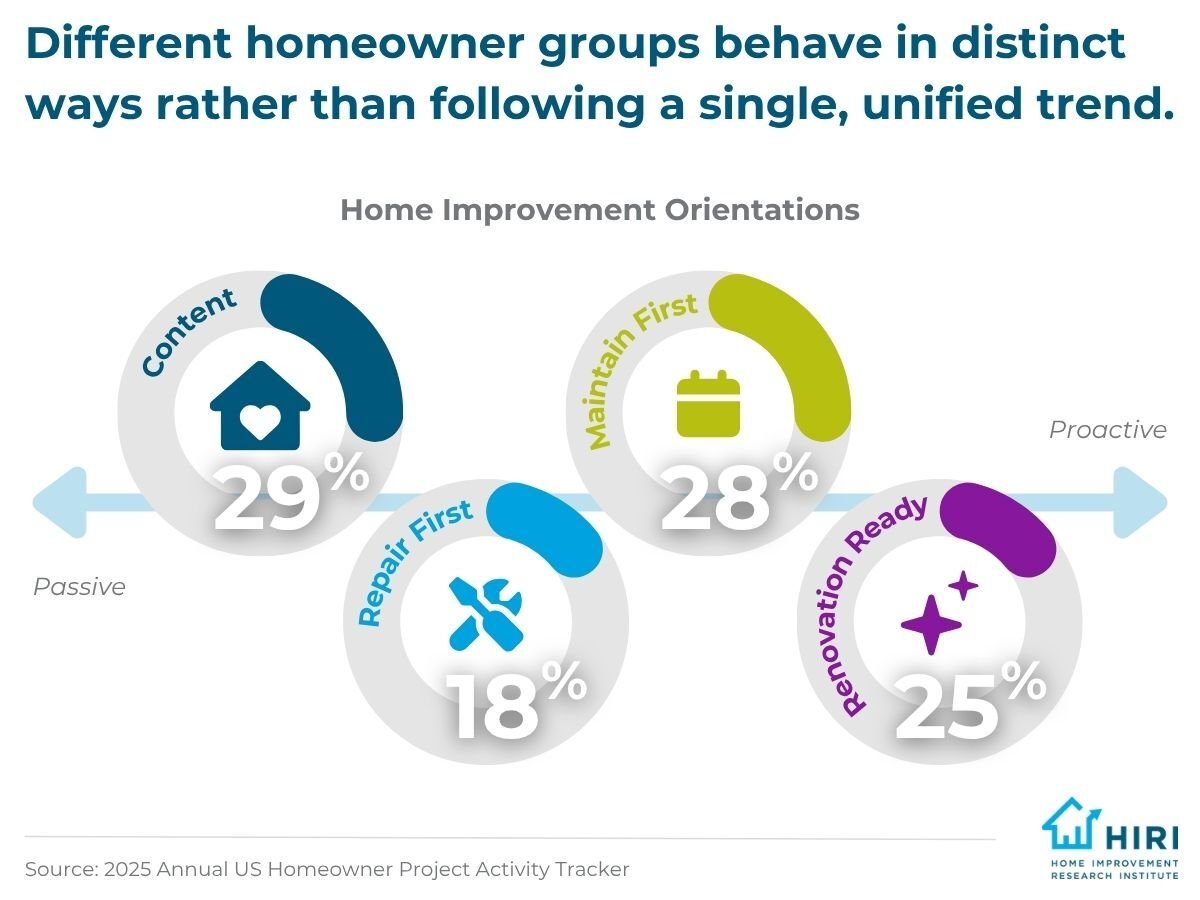
These groups emerge from shared patterns in the attitudes and behaviors most predictive of home improvement project activity, including spending expectations, project sentiment, planning behavior, home satisfaction, and repair versus replace decisions. Demographic patterns broadly align with the orientation spectrum, with older homeowners more prevalent in Content and Maintain First segments, while younger homeowners are more concentrated in Repair First and Renovation Ready.
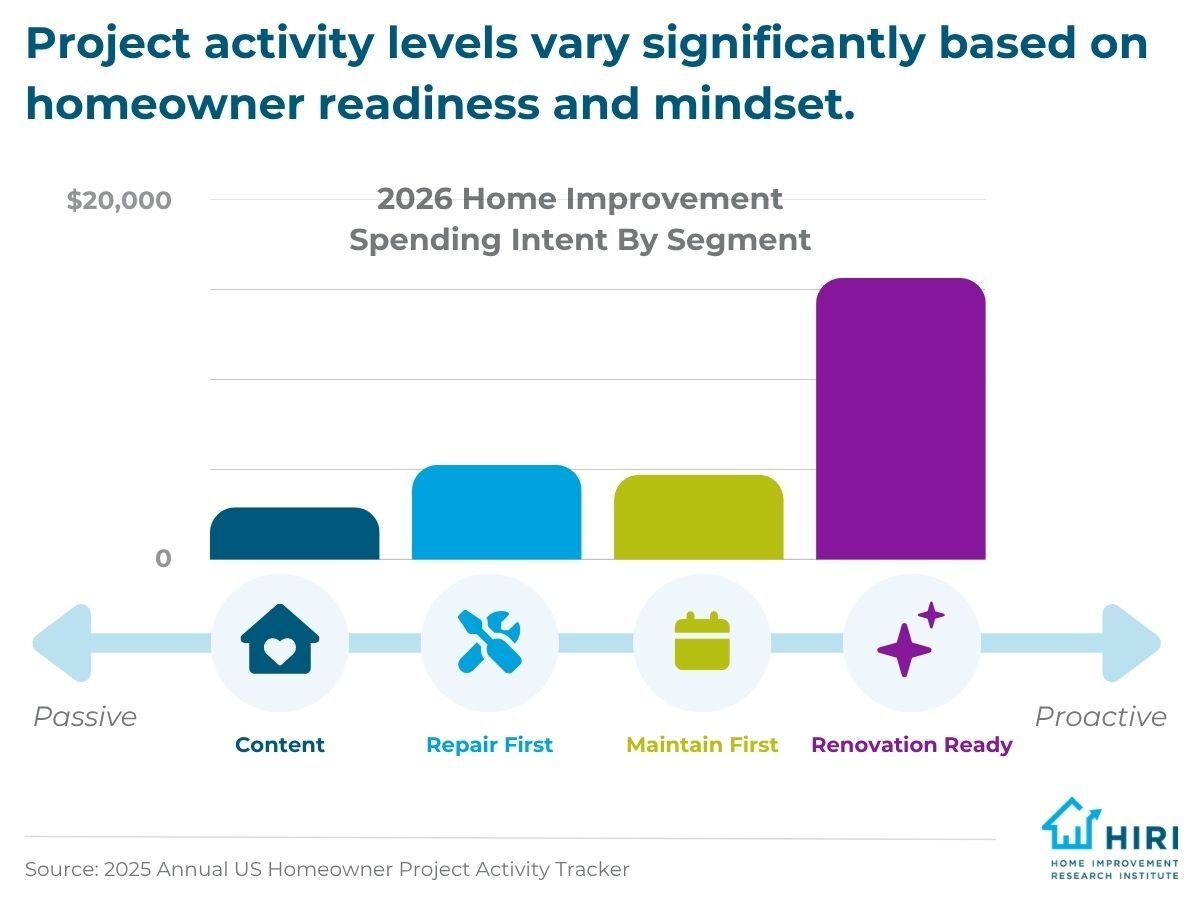
Planned investment increasingly concentrates among more proactive households. The percentage of homeowners in each segment who believe their home improvement spending will increase in the next 12 months compared to the past 12 months is:
- 15% of Content Homeowners
- 35% of Repair First Homeowners
- 26% of Maintain First Homeowners
- 57% of Renovation Ready Homeowners
While overall demand remains grounded in maintenance and repair, higher orientation segments expand both scope and spend, driving a widening gap in project intensity and reinforcing a more polarized market.
2. Maintain or Repair Remains Biggest Driver of Activity
Similar to 2024, the top reason for home improvement activity in 2025 was to maintain or repair the home. This was a driver for 76% of homeowners who conducted home improvement projects last year. Other top reasons for projects in 2025 included:
- Improve comfort (41%, same as 2024)
- Improve aesthetics (36%, compared to 38% in 2024)
- Safety and security (27%, compared to 25% in 2024)
- Increase functionality (26%, same as 2024)
- Increase home value (25%, compared to 29% in 2024)
- Energy efficiency (21%, compared to 23%)
What are the most popular home renovation projects this year?
The most popular home renovation projects for 2026 are concentrated in interior and outdoor projects. When asked what projects they had planned over the next 12 months, homeowners responded:
- Interior projects (50%)
- Yard, garden, and outdoor projects (48%)
- Exterior envelope projects (45%)
- Mechanical/structural/systems projects (22%)
- Major renovations (11%)
Building products manufacturers and suppliers should plan to align their product mix and inventory with steady repair demand, while also capturing growth in interior and exterior upgrade categories among more proactive homeowners.
3. Deferrals Edge Higher as Cost Sensitivity Deepens
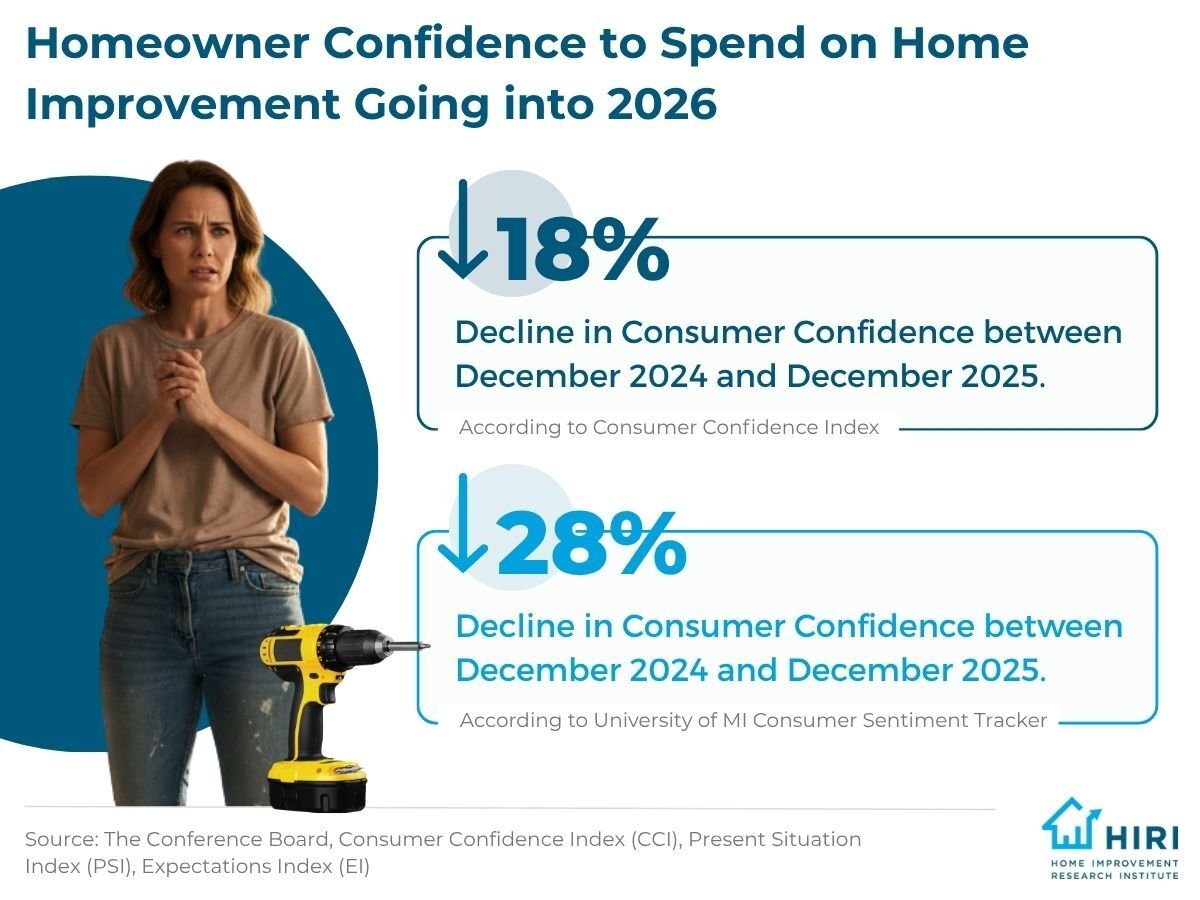
Home improvement inactivity in 2025 reflects a layered mix of financial caution, shifting priorities, and project complexity. Affordability pressures remain the primary barrier, contributing to a modest rise in delays and reinforcing cost as the dominant constraint on starting new work. For example, in 2025, 69% of homeowners cited budget/financial reasons as the motivation behind postponing or canceling their project, compared to 66% in 2024.While most homeowners still proceed with planned work, hesitation is more visible, particularly for larger or less urgent projects, signaling a more deliberate and selective approach to starting activity. In 2025, 42% of homeowners claimed budget constraints were the reason for not starting a home improvement project compared to 39% in 2024.Affordability concerns evolve from a background constraint into a more active decision filter. Households increasingly recalibrate project scope, favoring smaller, more controlled work while deferring discretionary upgrades, signaling a more disciplined and selective approach to spending.
The top factors that would motivate homeowners to start a project in 2026 include:
- Increased household income (47%, compared to 44% in 2024)
- Improved economic conditions (47%, compared to 38% in 2024)
- Financial incentives (38%, compared to 34% in 2024)
One consideration for manufacturers and suppliers is to reduce affordability barriers through pricing, incentives, and flexible payment, while simplifying project pathways to support more complex, higher-effort improvements.
4. Channel Behaviors are Changing Among Homeowners
Big box retailers remain the primary purchase channel with little change year over year, underscoring their continued central role in home improvement spend. However, modest gains in local hardware stores and lumber yards suggest a slight shift toward proximity driven and mission specific trips. The channels that homeowners used to purchase products and materials in 2025 were:
- Big-box retailers (72%, same as 2024)
- Local hardware stores (27%, compared to 23% in 2024)
- Online-only retailers (21%, compared to 19% in 2024)
- Mass retailers (21%, compared to 20% in 2024)
- Lumber yard/building material dealers (17%, compared to 13% in 2024)
- Specialty suppliers (14%, compared to 17% in 2024)
- Warehouse clubs (9%, compared to 8% in 2024)
- Direct from manufacturer (8%, compared to 7% in 2024)
HIRI’s research reveals that homeowner segment, more so than household income, is driving the growth in local hardware stores and lumber yards/building material dealers, as Renovation Ready owners focus on proximity and mission-focused retail.
While in store purchasing still dominates (used by 81% of homeowners in 2025), online delivery is edging higher, used by 30% of homeowners in 2025, compared to 28% in 2024. Meanwhile, the method of online ordering for in-store pickup decreased slightly in 2025.
Read more about Contractors' Top Channels for Home Improvement Purchases
5. Pure DIY is Declining in Favor of a Hybrid Approach
While more homeowners are doing DIY than hiring professionals for home improvement projects, there has been a decline in a purely DIY approach. The breakdown for home improvement completion methods in 2025 included:
- DIY (52%, compared to 57% in 2024)
- Both DIY and contractor (24%, compared to 20% in 2024)
- Hired a contractor (24%, compared to 23% in 2024)
There is some variance based on homeowner segment, with the Maintain First group having the highest rate of DIY (59%). Meanwhile, the Content segment is the most likely to hire a contractor, with 36% choosing that completion method in 2025.
How do homeowners decide between DIY and hiring a contractor?
Homeowners weigh a variety of factors when deciding between DIY and hiring a contractor. The main reasons for choosing DIY include:
- Cheaper if I did the work (67%)
- Able to do the work myself (68%)
- I enjoy the work (50%)
- Challenges of working with a pro (4%)
Meanwhile, HIRI’s 2025 Project Decision Study shows that homeowners are more likely to hire contractors for mid-to-large projects (upwards of $5k), because of the complexity. They also are motivated by the technical expertise, as well as the specialized knowledge and equipment, of professionals.
Know Your Market and Know Your Customer
As a HIRI member, you can gain access to the full U.S. Homeowner Project Activity Tracker for 2025, as well as the complete datasets included in HIRI’s ongoing quarterly Home Improvement Activity Tracker. This report identifies key trends and evolving behaviors in home improvement practices, including completed and planned projects, purchasing channels, product categories, and the factors influencing homeowner decision-making, helping organizations better understand and anticipate market opportunities.

FAQs:
Are homeowners doing more DIY or hiring professionals for home improvement projects?
While more homeowners are doing DIY than hiring professionals for home improvement projects, there has been a decline in a purely DIY approach, based on findings from the Home Improvement Research Institute’s 2025 U.S. Homeowner Project Activity Tracker. The breakdown for home improvement completion methods in 2025 included DIY (52%); both DIY and contractor (24%); and hired a contractor (24%). Meanwhile, HIRI’s 2025 Project Decision Study shows that homeowners are more likely to hire contractors for mid-to-large projects (upwards of $5k), because of the complexity. They also are motivated by the technical expertise, as well as the specialized knowledge and equipment, of professionals.
What is the forecast for residential remodeling activity?
Based on HIRI's home improvement research, while project activity remains stable in 2026, homeowners seem to be favoring smaller, necessary work, while only renovation-oriented households maintain stronger intent and broader improvement engagement. At the end of 2025, about 50% of homeowners were planning to undertake home maintenance in the near future; 34% were planning home repairs; and 25% were planning a renovation project.
What are the most popular home renovation projects this year?
The most popular home renovation projects for 2026 are concentrated in interior and outdoor projects, based on homeowners’ intentions as surveyed in the Home Improvement Research Institute’s 2025 U.S. Homeowner Project Activity Tracker. Throughout this year, the projects that homeowners were planning to pursue included interior projects (50%); yard, garden, and outdoor projects (48%); exterior envelope projects (45%); mechanical/structural/systems projects (22%); and major renovations (11%). HIRI's research also has found that exterior projects are the most common and maintenance oriented, while interior projects are generally discretionary, with contained scope. Mechanical work is less frequent but higher spend and financing driven. Additionally, home improvement activity follows a consistent seasonal arc, but timelines diverge meaningfully by project type.