

Economic pressure remains elevated in the home improvement market, with homeowners growing more financially cautious. However, contractor activity is stable, with demand being primarily driven through repair and replacement work.
Scaled-back projects and weaker margins signal continued tension, with 51% of contractors feeling there is more competition in the market compared to a year ago. However, the majority is also expecting growth over the next 12 months, both across the home improvement industry and individually, based on data from the Quarterly Contractor Activity Tracker for Q3 2026, developed by the Home Improvement Research Institute (HIRI) in partnership with The Farnsworth Group.
For manufacturers and suppliers operating in this tight market—which is likely to persist through the beginning of 2027—it is important to stay on top of changing conditions and trends in contractor behaviors and sentiment. This data can inform your strategies when tailoring product development and inventory, as well as marketing and messaging, to address the challenges that industry professionals are facing. Offering them the right support, tools, product mix, and engagement can help brands succeed, despite continued pressure within the market.
What Trends are Driving Demand in the Contractor Segment?
Contractor activity remained resilient in Q3 2026, supported by strong project conversion, despite persistent macroeconomic concerns. Overall challenges shifted little, but closing new business, cash flow, and supplier concerns gained prominence.
Here is a closer look at a few of the key trends shaping contractor sentiment and home improvement activity heading into the end of 2026 and the beginning of 2027:
1. Economic Concerns Persist in Q3 2026
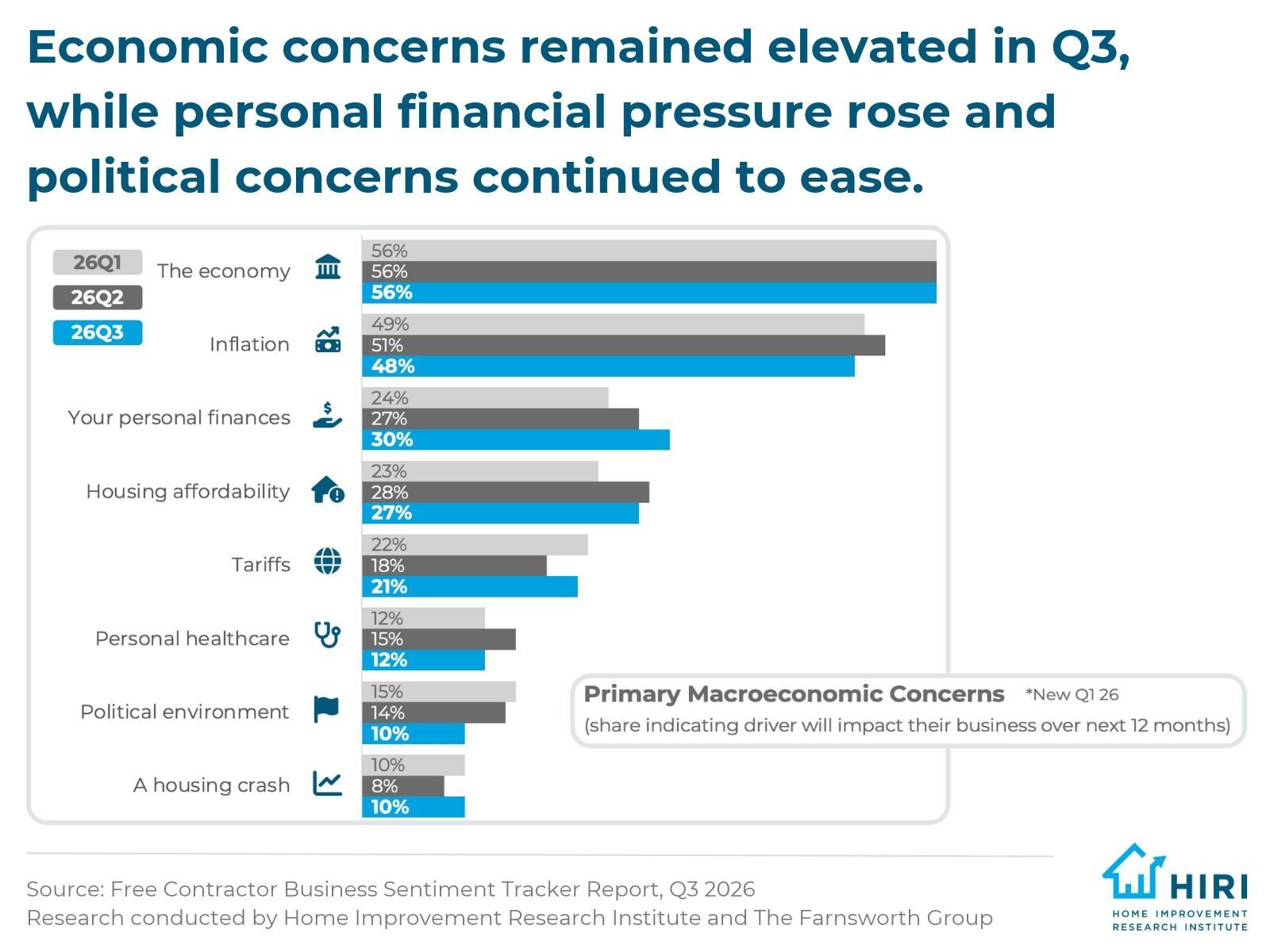
Economic concerns remained elevated in the third quarter of 2026, with 56% of contractors indicating the economy will impact their business over the next 12 months (the same percentage as the preceding two quarters). Inflation concerns eased slightly (down to 48% from 51% in Q2 2026), while personal finances are a growing concern. In 2026, personal finances were cited as a primary macroeconomic challenge by:
- 30% of contractors in Q3 2026
- 27% of contractors in Q2 2026
- 24% of contractors in Q1 2026
However, financing patterns changed little throughout the quarter, with contractor-arranged financing stable and customer access to financing having limited influence on overall project activity. About half of contractors said homeowner access to financing has not affected project activity at all, and only 22% report that it “somewhat increased” or “significantly increased” project activity. In light of these macroeconomic concerns, building products brands should emphasize affordability and essential project needs, as homeowners remain cautious and contractors balance resilient demand against continued profitability pressure.
2. Project Cancellations and Postponements Ease Slightly
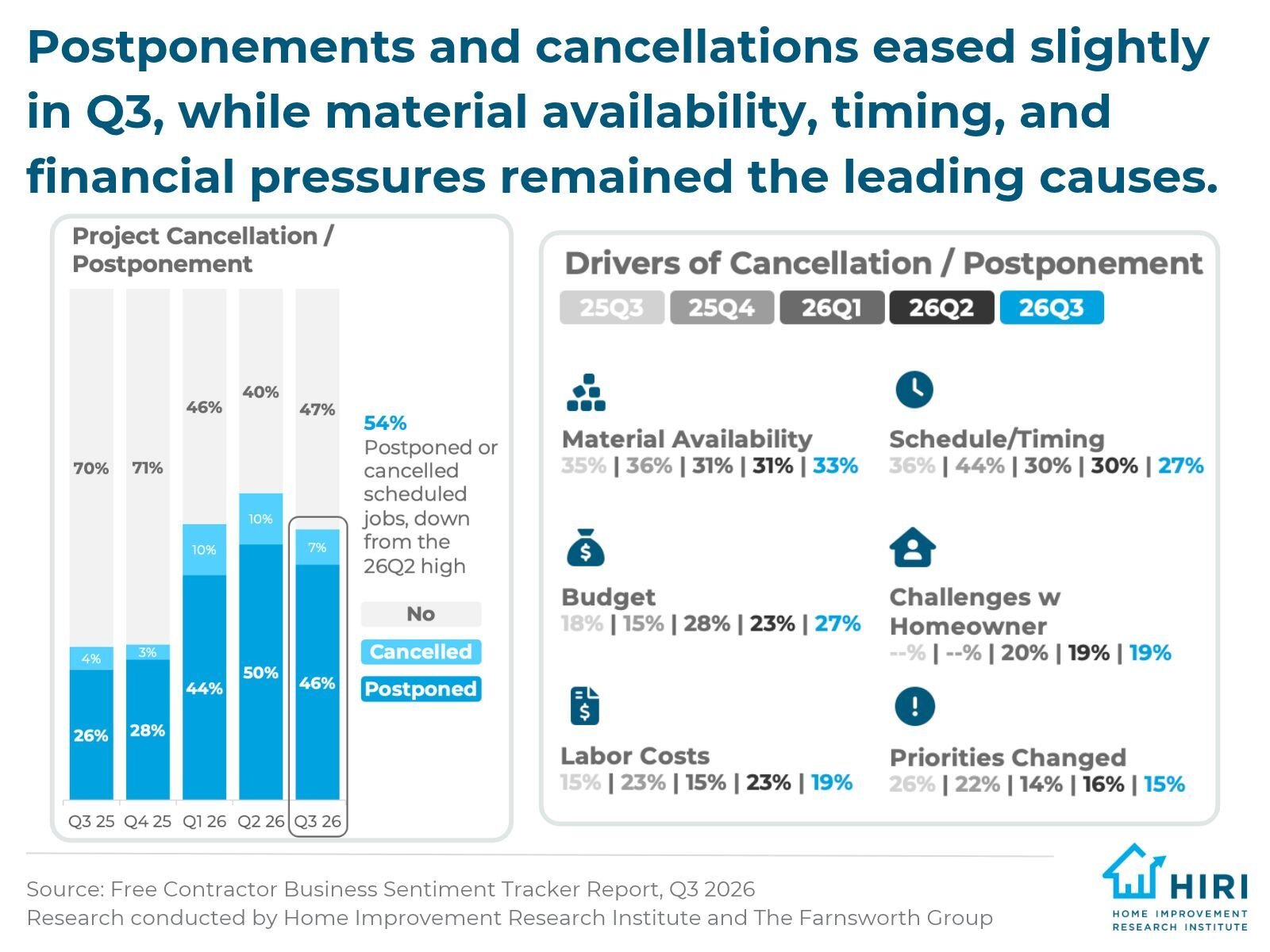
Despite ongoing headwinds, contractors reported improved project activity across most pipeline stages in Q3 in HIRI's Contractor Business Sentiment Tracker for Q3 2026. Approximately 56% of contractors said this past year was better in terms of revenue growth compared to the year before (compared to 52% of contractors in Q2 2026). Additionally, fewer contractors postponed scheduled jobs in Q3, while budget constraints, underestimated timelines, and contractors’ own decisions became more prominent causes. Labor costs receded as a driver for delays and cancellations.
Overall, in Q3 2026:
- 46% of contractors reported postponed jobs (down from 50% in Q2 2026)
- 7% of contractors reported cancelled jobs (down from 10% in Q2 2026)
While there has been some improvement in the latter half of 2026, these postponement and cancellation rates are still nearly double what industry pros reported in the same quarter last year: 26% postponed jobs and 4% cancelled jobs.
For about two-thirds of contractors, customers are at least sometimes requesting a scaled-down version of a quoted project, rather than walking away.
3. Material Costs and Labor Remain Leading Challenges
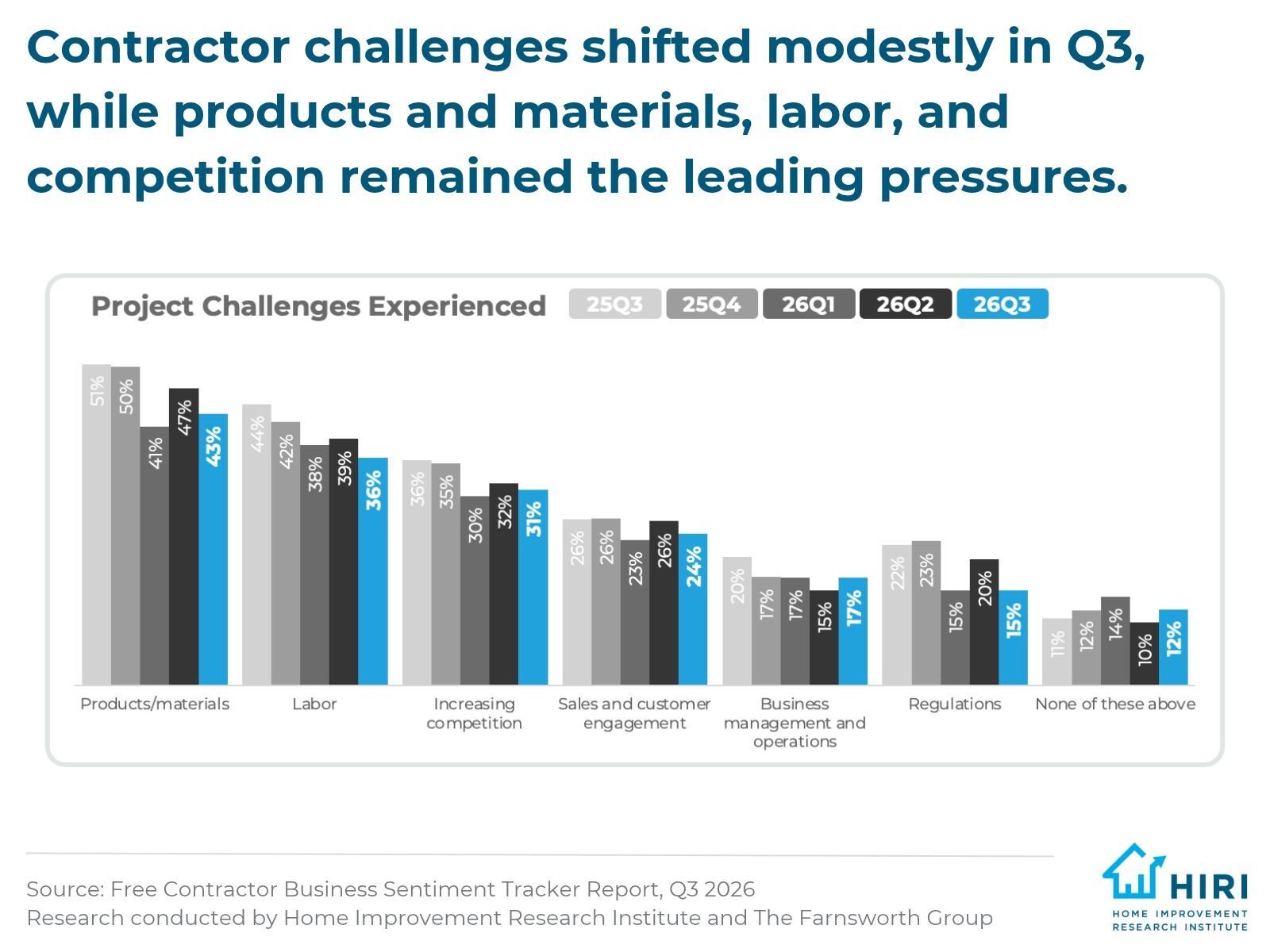
Products and materials remained the most common project challenge, cited by 43% of contractors, followed by:
- Labor (36%)
- Increasing competition (31%)
- Sales and customer engagement (24%)
In all four areas, project challenges have lessened compared to the same quarter last year. Homeowner challenges also remained broadly stable in Q3 2026, with indecision still the leading concern; on the flip side, timely payment, cost constraints, and scheduling conflicts improved.
Cost continues to be dominant product challenge
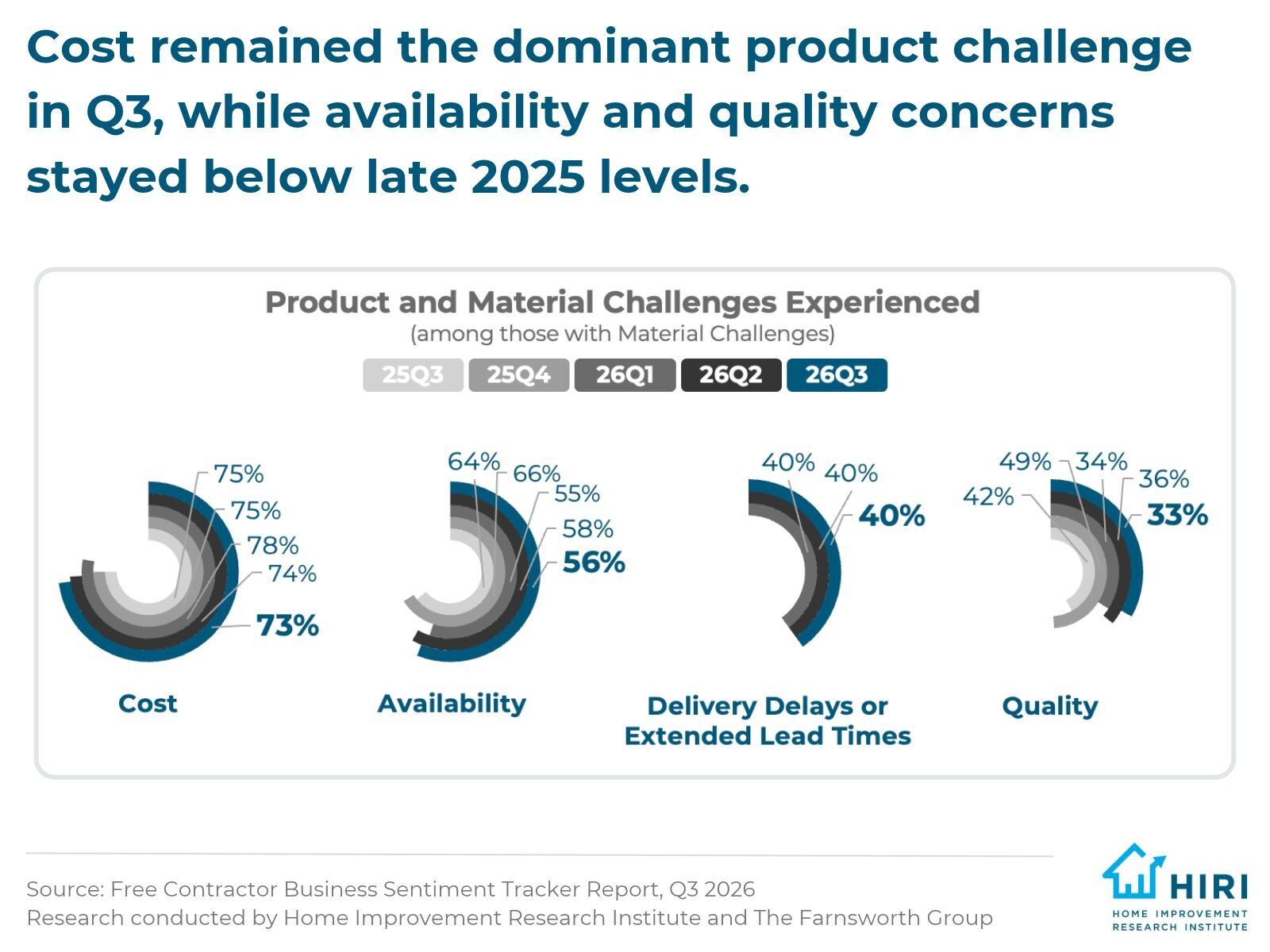
Among contractors who are experiencing material challenges, 73% identified cost as a key concern. This is relatively on par with the same quarter last year, when 75% of contractors called out cost as a main challenge related to products and materials. Quality and availability stayed below their late-2025 levels.
During Q3 2026, more contractors passed full material cost increases to customers, while fewer absorbed those pressures through margins, potentially adding to homeowners’ financial constraints. Going forward, manufacturers and suppliers can support contractors by encouraging sustained pricing discipline and flexible project options, as steady demand and persistent cost pressure require careful margin management and customer affordability tradeoffs.
4. Revenue Optimism Holds Despite Growing Competition
In HIRI's Quarterly Contractor Business Sentiment Tracker, 51% of contractors reported increased competition compared to a year ago, 60% still anticipate revenue growth over the next 12 months. This is comparable to 57% reporting the same growth optimism last year, in Q3 2025.
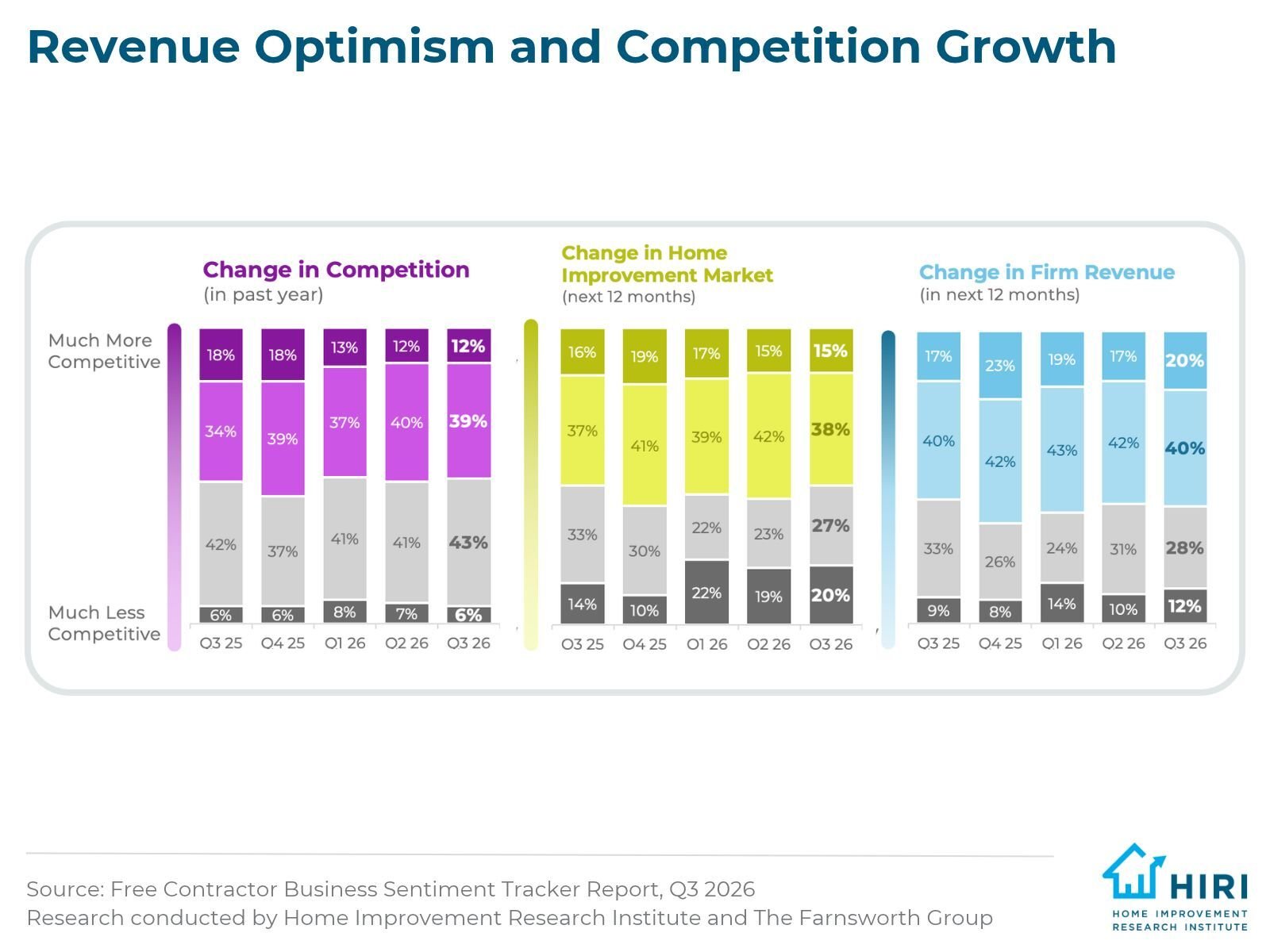
Contractors also remained cautiously growth-oriented in Q3, with 53% of contractors sharing that they expect the home improvement market to grow in the next year, the same as in Q3 2025. The areas where contractors perceive the biggest opportunity for growth include:
- Energy efficiency improvements (20%)
- Technology integration (16%)
- Expansion into new geographic markets (9%)
For manufacturing brands, a key consideration is supporting contractors with tools that improve sales conversion, cash flow, and customer decision-making while offering affordable project options amid elevated competition.
5. Contractor Purchasing Remains Broad in Q3 2026
Product purchasing remained broad and core-focused among contractors in Q3, while product availability and quality challenges continued to ease from late 2025. The building product categories with the highest purchase incidence rate include:
- Building materials and structural systems (with 92% of contractors making a purchase in this category in Q3 2026)
- Exterior envelope (78%)
- Interior finish (73%)
- Tools and accessories (67%)
In general, contractors purchase more broadly across product categories than homeowners, with the widest gaps in tools, structural materials, and exterior products.
Primary product challenges in Q3 2026
Cost remained the leading concern in the third quarter of 2026, affecting 73% of industry professionals. Availability is also a dominant challenge, experienced by 56% of contractors, although it is impacting fewer pros in 2026 than in the later part of 2025. The same applies to quality as a product challenge.
Additionally, manufacturer challenges eased and supplier friction remained concentrated around availability, delivery timing, and pricing. When working with the contractor segment, consider ways to prioritize reliable availability, delivery, and pricing support, while maintaining strong service and communication around core project products amid persistent cost pressure.
Using Research to Effectively Engage Home Improvement Pros
The construction industry is constantly evolving, shaped by economic conditions, market shifts, and industry-wide challenges. To help industry stakeholders stay on top of these shifts, the Quarterly Contractor Business Sentiment Tracker provides a comprehensive view of project activities, the factors influencing contractors’ operations, and how economic and industry trends are impacting their businesses and attitudes.
HIRI members have access to the full report, along with a wide range of other research reports, webinars, and other resources. Every report is tailored to help you make decisions that immediately impact your business. Plus, members have access to the full data set from every study so that they can conduct additional analysis as desired.
FAQS
1. What are the biggest challenges facing home improvement contractors?
Products and materials were the most common project challenge in Q3 2026, cited by 43% of contractors, followed by labor at 36% and increasing competition at 31%. Among contractors experiencing material challenges, 73% identified cost as a concern. These findings from HIRI’s Quarterly Contractor Business Sentiment Tracker, developed in partnership with The Farnsworth Group, highlight the importance of competitive pricing, reliable product availability, and supplier support that helps contractors protect margins while meeting customers’ budgets.
2. Are homeowners postponing or cancelling home improvement projects?
Project disruptions eased in Q3 2026, but remained elevated compared with a year earlier. Forty-six percent of contractors reported postponed jobs, down from 50% in Q2, while 7% reported cancellations, down from 10%. Homeowners are also adjusting project scope rather than abandoning improvements altogether. About two-thirds of contractors said customers at least sometimes request scaled-down versions of quoted projects, reinforcing the value of flexible options that address essential needs while accommodating tighter household budgets.
3. Do contractors expect their businesses to grow over the next year?
Despite persistent economic pressure, 60% of contractors surveyed in Q3 2026 expected revenue growth over the next 12 months, compared with 57% a year earlier. Meanwhile, 53% anticipated growth across the home improvement market. That optimism coexists with tougher competition: 51% reported increased competition compared with the previous year. Energy efficiency improvements and technology integration stood out as perceived growth opportunities, suggesting potential for brands that help contractors communicate value and win new business.
4. Which building product categories are contractors purchasing most?
Contractor purchasing remained broad in Q3 2026, with the highest purchase incidence in building materials and structural systems: 92% of contractors bought products in this category. Exterior envelope products followed at 78%, interior finishes at 73%, and tools and accessories at 67%. These figures reflect how many contractors purchased within each category, not spending share. For manufacturers and suppliers, the findings underscore the importance of dependable inventory and service across core project categories.
5. How can manufacturers and suppliers better support contractors?
Manufacturers and suppliers can support contractors by prioritizing reliable availability, predictable delivery, and clear pricing while offering product options for different budgets. With homeowners requesting smaller projects and contractors facing margin pressure, resources that simplify product selection and demonstrate value can help. HIRI’s Quarterly Contractor Business Sentiment Tracker, developed in partnership with The Farnsworth Group, helps brands track these pressures and align inventory, messaging, and contractor support with changing market conditions.