
When it comes to home improvement, what's on the outside is just as important as what's on the inside. For homeowners, taking care of their gardens and lawns is an important part of regular maintenance and stewardship of their space.
But for these types of projects in particular, there seems to be something pleasurable about it that goes beyond habit or obligation. A significant percentage of homeowners enjoy the process of working outdoors and the satisfaction that comes from completing a task. Additionally, they see these types of projects as an opportunity to cut down on costs by doing the work themselves, rather than hiring a professional.
However, for mid-to-large outdoor projects, contractors are still hired on a regular basis, driven by a need for their technical expertise, work quality, and the ease and convenience of having assistance. When they are involved in yard, garden, and outdoor projects, they play a significant role in selecting and purchasing products and materials. For that reason, manufacturers and suppliers should be aware of the influences and resources used in selecting and managing projects, professionals and materials, as well as the main product-purchasing channels used, and strategize around these trends.
Market Forecast and Industry Trends for Outdoor Project Purchases from 2026 to 2030
The consumer, or DIY homeowner, market for lawn and garden supplies, nursery stock and soil treatments is significantly larger than the pro market. This is one area of home improvement where property owners are more prone to undertake their own DIY projects, repairs, and maintenance activities. Based on data from HIRI’s March 2026 U.S. Size of the Home Improvement Products Market Report, the main product categories related to outdoor projects include:
- Lawn and garden equipment and supplies
- Nursery stock and soil treatments
The overall market for lawn and garden equipment supplies saw a compound annual growth rate (CAGR) of 7.4% from 2020 to 2026, and nursery stock and soil treatments had a CAGR of 3.1% in the same period.
How is the lawn and garden home improvement market expected to grow this year?
The market for lawn and garden equipment and supplies is expected to grow by roughly 3.3% from 2026 to 2030, while nursery stock and soil treatments is expected to grow by 3.4%; when adjusted for inflation, the projected growth is closer to 1.9% and 2.1%, respectively.
Consumer spending for lawn and garden home improvements should remain steady. The anticipated CAGR for lawn and garden equipment supplies among homeowners is 3.2% from 2026 to 2030, which is an increase from approximately $42.25 billion to $48.01 billion in 2030. The projected CAGR for nursery stock and soil treatments is 3.3%, an increase from approximately $23.24 billion to $26.49. For the professional side of the market, the anticipated CAGR in the forecast period is slightly lower, or 2.4% for lawn and garden equipment and supplies (an increase from $5.82 billion to $6.76 billion) and 2.4% for nursery stock and soil treatments (an increase from $6.63 billion $7.7 billion).
What are homeowners spending on lawn and garden projects?
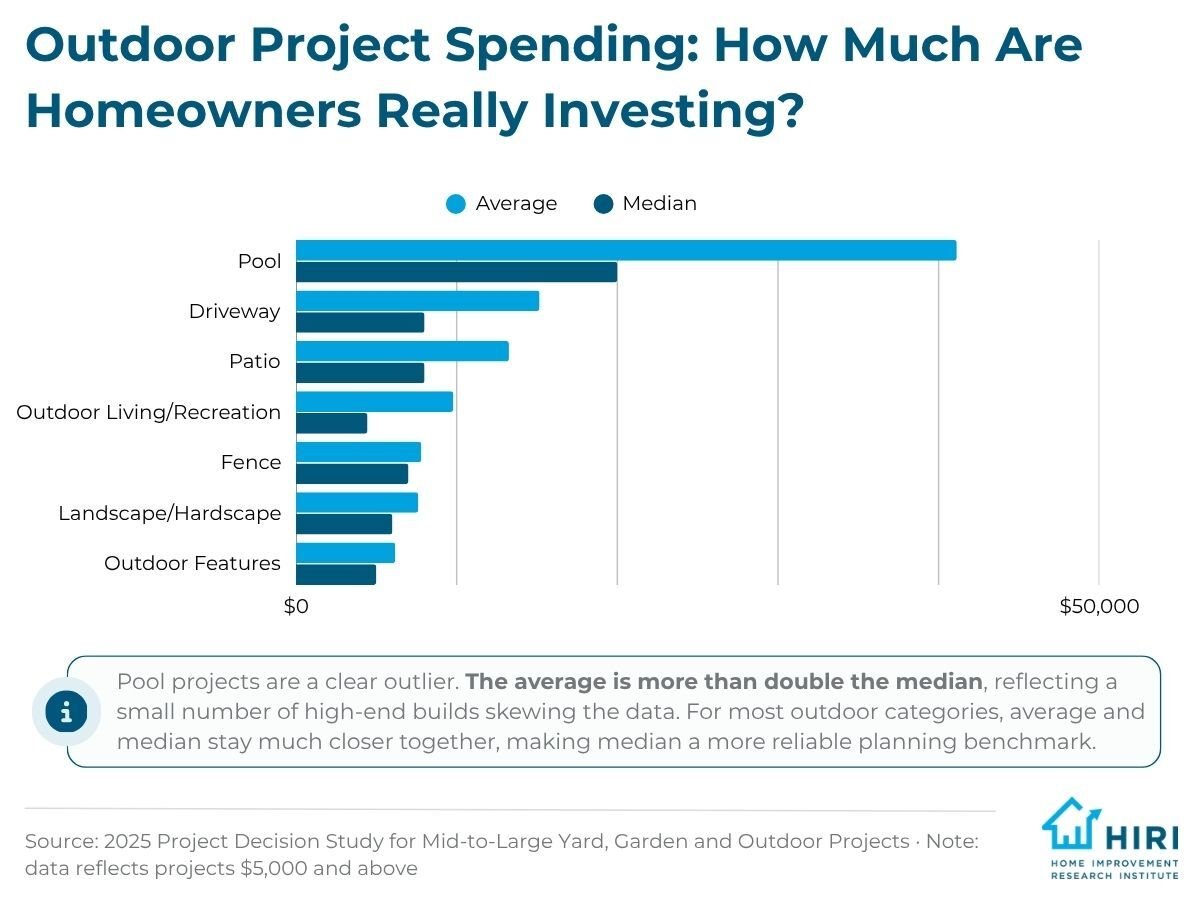
The average home improvement spending for overall yard, garden and outdoor projects was $13,447 in 2025 and the median spend was $7,000, according to HIRI’s 2025 Project Decision Study for mid-to-large Yarde, Garden and Outdoor Projects.
A majority of outdoor projects fall within the $5k to $9.9k or $10k to $24.9k range. The notable exception is for pool projects, where 23% fall in the $25k to $49.9k range and 28% cost $50k-plus. Driveways and patios form a clear mid-tier. HIRI members can get a breakdown of the average and median spend across different projects in the study. This includes the amount spent on:
- Landscape/hardscape
- Pool
- Fence
- Driveway
- Patio
- Outdoor living/recreation
- Outdoor features
Most outdoor projects are cash funded, although outdoor living relies more heavily upon financing than other categories.
What are the Latest Trends in Lawn and Garden Home Improvements?
It’s important for manufacturers and suppliers to understand what factors are driving growth in the lawn and garden renovations and what types of projects are completed most frequently, as well as what motivates these improvement activities and how contractors and other industry professionals factor into the mix. This data can be used to design category-specific engagement strategies that address homeowner inspiration points, in addition to contractor influence across sourcing, materials, and execution.
What are the most popular lawn and garden improvements right now?
Based on findings from HIRI’s annual U.S. Homeowner Project Activity Tracker Report, 33% of homeowners did a project involving their yard, garden, or landscape in the past three months. This is a slight increase from 32% in 2024. HIRI’s quarterly U.S. Homeowner Project Activity for Q1 2026 explored what projects homeowners are planning to pursue in the next 12 months. The most popular lawn and garden improvements right now based on homeowners’ intended projects include:
- Adding or replacing trees/plants/shrubs (14%)
- Add/repair/replace driveway (9%)
- General landscaping (9%)
- Fencing (8%)
- Add/repair/replace walkway (7%)
- Outdoor lighting (6%)

What are the main motivations for outdoor improvement projects?
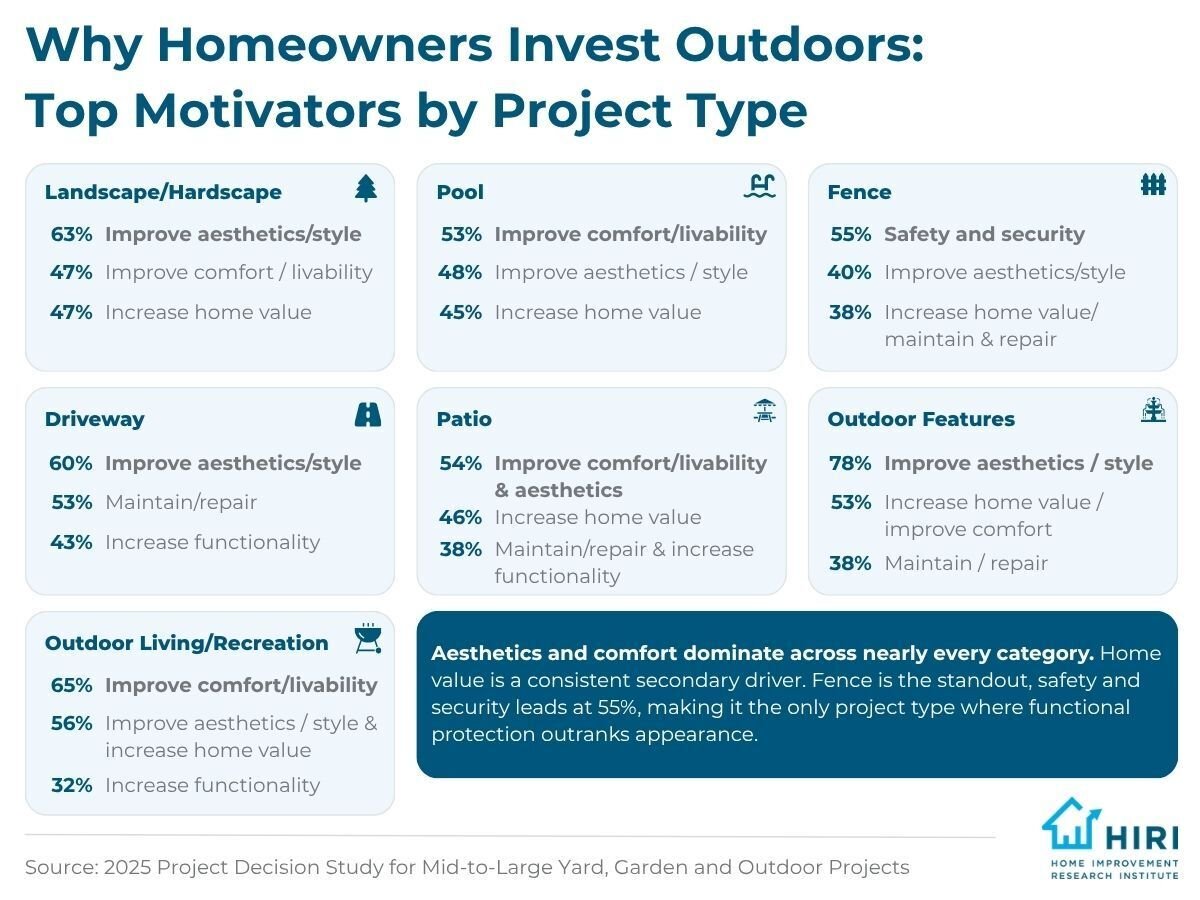
For the most part, outdoor projects are driven by comfort, aesthetics, and increasing home value.
The top project motivations for landscape/hardscape activities are:
- Improve aesthetics/style (63%)
- Improve comfort/livability (47%)
- Increase home value (47%)
The top project motivations for pools are:
- Improve comfort/livability (53%)
- Improve aesthetics/style (48%)
- Increase home value (45%)
The top project motivations for fencing are:
- Safety and security (55%)
- Improve aesthetics/style (40%)
- Increase home value and maintain/repair (38%)
The top project motivations for driveways are:
- Improve aesthetics/style (60%)
- Maintain/repair (53%)
- Increase functionality (43%)
The top project motivations for patios are:
- Improve comfort/livability and improve aesthetics/style (54%)
- Increase home value (46%)
- Maintain/repair and increase functionality (38%)
The top project motivations for outdoor living/recreation projects are:
- Improve comfort/livability (65%)
- Improve aesthetics/style and increase home value (56%)
- Increase functionality (32%)
The top project motivations for outdoor features are:
- Improve aesthetics/style (78%)
- Increase home value and improve comfort/livability (53%)
- Maintain/repair (38%)
Outdoor projects deliver broad benefits for property owners, led by aesthetics and comfort, with functional and safety gains varying by project type.
Are more people doing DIY or hiring professionals for garden and yard improvements?
Completion methods for yard, garden, and outdoor projects skews toward contractors, especially for pools, driveways, fences, and hardscape projects, reflecting scale and technical demand. Outdoor living and smaller projects show higher DIY or hybrid participation, driven by cost savings and homeowner capability. Overall, the project completion methods for yard, garden, and outdoor projects in 2025 included:
- Contractor (66%)
- Both DIY and contractor (21%)
- DIY and/or friends/family (14%)
Notably, these households spent more than $5,000 on their projects, so these completion patterns reflect larger jobs, where professional labor is more common. The reasons for completing projects DIY were:
- Able to do the work myself (60%)
- Cheaper if I did the work (57%)
- I enjoy the work (51%)
- Wanted to ensure quality/workmanship (34%)
- Challenges of working with a pro (13%)
The top reasons for hiring a professional for the work were:
- Technical expertise (65%)
- Work quality (62%)
- Ease and convenience (53%)
These motivations vary slightly across specific outdoor projects. For example, for fence and patio projects, guaranteed workmanship becomes a top driver, whereas access to specialized tools/equipment is more important for landscaping and hardscaping.
How do trends in lawn and garden projects differ by region?
Yard, garden and outdoor projects skew southern overall, but outdoor living and features are done almost as or more frequently in the west than the south, reflecting climate-drive lifestyle investments. For example, here is where homeowners who completed mid-to-large outdoor projects in 2025 lived:
- South (45%)
- West (24%)
- Midwest (18%)
- Northeast (13%)
For pools and fences, more than half of these projects are completed by homeowners in the south.

How Should Product Manufacturers Respond to Consumer Attitudes and Behaviors?
For manufacturers and suppliers of lawn and gardening products and materials, it's useful to understand how and where professionals and homeowners are making their purchases.
Products Purchased for Yard, Garden and Outdoor Projects
Yard projects see concentrated spending on outdoor living and structural materials, with limited crossover into mechanical, interior, or appliance categories. The product categories that have a high purchase rate include:
- Concrete, masonry and/or stone
- Outdoor living
- Landscaping supplies
- Fencing
- Adhesives, caulks, sealants, etc.
- Lumber
- Paint and/or stain
Additionally, HIRI’s 2025 U.S. Homeowner Project Activity Report revealed that homeowners had purchased these products for projects at their residence:
- Landscaping supplies (29%)
- Outdoor lighting (15%)
- Concrete, masonry, and/or stone (9%)
- Standalone grills and/or fire pits (9%)
- Outdoor living supplies and materials (7%)
- Fencing (6%)
- Outdoor storage sheds (3%)
Where Do Homeowners Purchase Products for Outdoor Products?
Big-box retailers are overwhelmingly favored as the main purchase channel for yard, garden and outdoor products and materials. In 2025, here is where purchasing took place for outdoor projects:
- Big-box retailers (71%)
- Online-only retailers (27%)
- Mass retailers (23%)
- Local hardware stores (21%)
- Specialty suppliers (21%)
- Lumber yard/building material dealer (21%)
- Direct from manufacturer (13%)
- Warehouse club (13%)
The purchase and delivery method for yard, garden and outdoor projects was:
- In-store shopping and pickup (54%)
- In-store shopping with delivery (41%)
- Online ordering and delivery (38%)
- Online ordering and in-store pickup (18%)
Additional tools are purchased for outdoor projects about one-quarter of the time, on average.
Gaining Insights on Garden, Lawn, and Landscaping Trends
If you're looking for other insights and data to help inform your decisions as a manufacturer, HIRI offers a wide range of research on market trends for landscaping and gardening, as well as consumer behaviors and attitudes when making purchases in these categories. To get access to the full 2025 Project Decision Study and both quarterly and annual homeowner activity trackers, become a member of HIRI.
Whether you're navigating new trends, refining product development strategies, or ensuring your marketing efforts are on target, HIRI equips you with the actionable insights you need to stay ahead of the competition.

FAQs
How is the lawn and garden home improvement market expected to grow this year
According to the March 2026 release of HIRI's U.S. Size of Market Forecast, the market for lawn and garden equipment and supplies is expected to grow by roughly 3.3% from 2026 to 2030, while nursery stock and soil treatments is expected to grow by 3.4%; when adjusted for inflation, the projected growth is closer to 1.9% and 2.1%, respectively. The anticipated CAGR for lawn and garden equipment supplies among homeowners is 3.2% from 2026 to 2030, which is an increase from approximately $42.25 billion to $48.01 billion in 2030. The projected CAGR for nursery stock and soil treatments is 3.3%, an increase from approximately $23.24 billion to $26.49. For the professional side of the market, the anticipated CAGR in the forecast period is slightly lower, or 2.4% for lawn and garden equipment and supplies (an increase from $5.82 billion to $6.76 billion) and 2.4% for nursery stock and soil treatments (an increase from $6.63 billion $7.7 billion). Updated figures in HIRI's June 2026 and subsequent quarterly release of the Size of Market Forecast are available to HIRI Members.
What are homeowners spending on lawn and garden projects?
Overall, the average home improvement spending for mid-to-large yard, garden and outdoor projects was $13,447 in 2025 and the median spend was $7,000, according to the Home Improvement Research Institute's 2025 Project Decision Study for mid-to-large Yarde, Garden and Outdoor Projects. A majority of outdoor projects fall within the $5k to $9.9k or $10k to $24.9k range. The notable exception is for pool projects, where 23% fall in the $25k to $49.9k range and 28% cost $50k-plus. Driveways and patios form a clear mid-tier. Most outdoor projects are cash funded, although outdoor living relies more heavily upon financing than other categories.
How do trends in lawn and garden projects differ by region?
The south region represents the largest share of yard, garden and outdoor projects. Based on data from the Home Improvement Research Institute's Project Decision Study for mid-to-large Yard, Garden and Outdoor Projects, 45% of these projects are completed by homeowners in the south. Another 24% are done by homeowners in the west, 18% are done in the Midwest, and 13% are done in the northeast. For pools and fences, more than half of these projects are completed by homeowners in the south. However, 41% of outdoor living/recreation projects and 41% of outdoor features are completed in the west, reflecting climate-drive lifestyle investments.
Are more people doing DIY or hiring professionals for garden improvements?
Completion methods for yard, garden, and outdoor projects skews toward contractors, especially for pools, driveways, fences, and hardscape projects, reflecting scale and technical demand. According to the Home Improvement Research Institute's Project Decision Study for mid-to-large Yard, Garden and Outdoor Projects, outdoor living and smaller projects show higher DIY or hybrid participation, driven by cost savings and homeowner capability. Overall, the project completion methods for mid-to-large yard, garden, and outdoor projects in 2025 were: contractor (66%); both DIY and contractor (21%); and DIY and/or friends/family (14%). The top reasons for hiring a professional for the work were technical expertise (65%); work quality (62%); and ease and convenience (53%).
What are the most popular lawn and garden improvements right now?
The most popular lawn and garden improvements right now include adding or replacing trees/plants/shrubs; add/repair/replace driveway; general landscaping; fencing; add/repair/replace walkway; and outdoor lighting, based on what projects homeowners are planning to pursue in the next 12 month, according to the Home Improvement Research Institute’s U.S. Homeowner Project Activity for Q1 2026. Meanwhile, the product categories with the highest purchase incidence over the past three months include landscaping supplies; outdoor lighting; and concrete, masonry, and/or stone.