
Despite a continued level of financial strain and tempered customer confidence to start 2026, the home improvement products market in the United States is expected to continue growing over the next few years. Home maintenance, repairs, and upgrades are a consistent spending category for households across the U.S.
What Market Trends are Influencing Homeowner Spending in 2026?
There are some variations in spending behaviors and perceptions that we need to unpack based on several factors (such as household income level, age bracket, and other demographics) and larger economic trends also come into play when exploring current and future trends in the home improvement market.
Based on findings from the Home Improvement Research Institute’s 2025 Project Decision Study, the activities typically pursued by homeowners span a necessary to discretionary spectrum.
-
Exterior projects are the most common and maintenance oriented, while interior projects are generally discretionary, with contained scope.
-
Mechanical work is less frequent but higher spend and financing driven.
-
Additionally, home improvement activity follows a consistent seasonal arc, but timelines diverge meaningfully by project type.
Looking ahead, home improvement product manufacturing brands can respond to these and other emerging trends by aligning their products, services, and financing to project necessity; activating homeowners with digital inspiration and tools; and equipping contractors with sourcing, compliance, and fulfillment support across complex projects.
Forecasted Growth Rate of Home Improvement Market
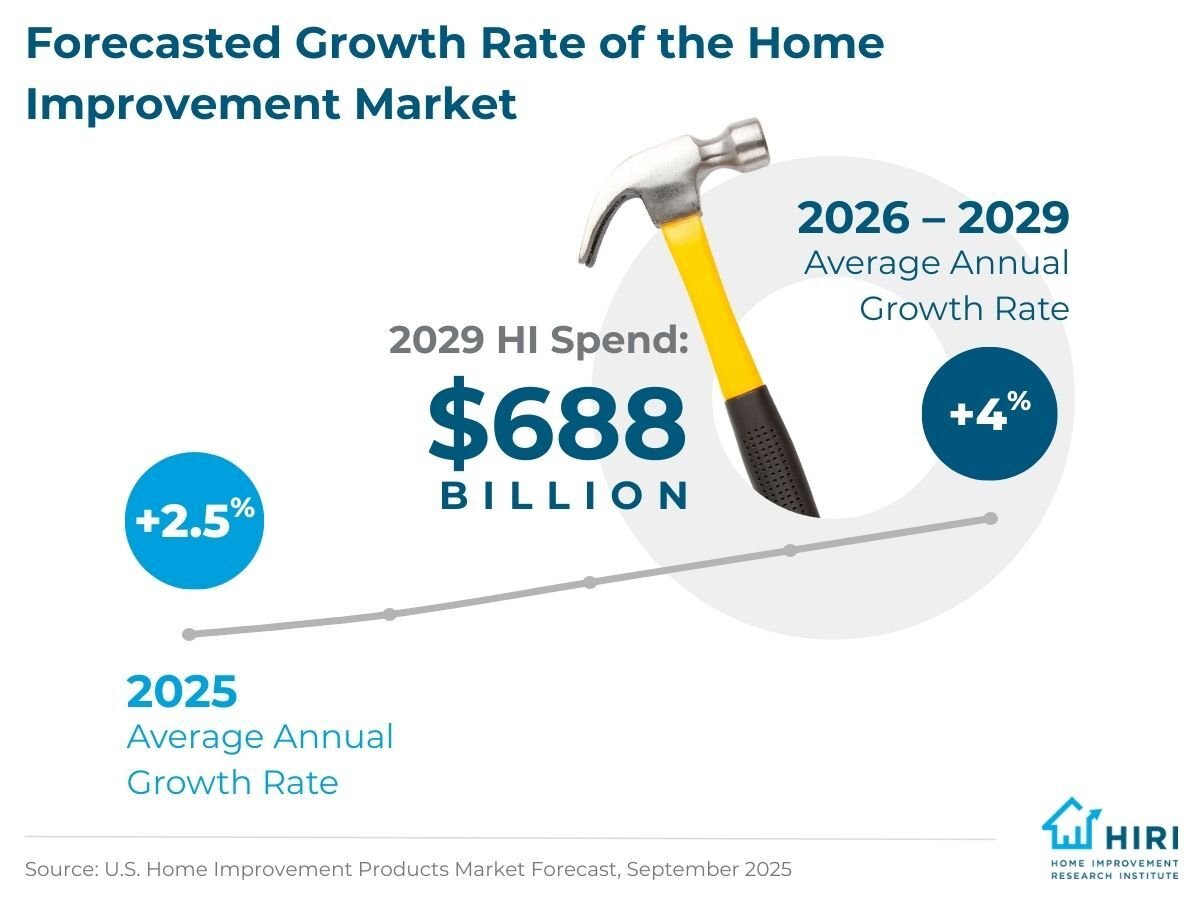
The home improvement products market in the United States was projected to increase about 2.5% in 2025, with an average 4% annual growth rate from 2026 to 2029. The market is forecasted to reach about $688 billion by 2029, based on data from HIRI’s U.S. Size of the Home Improvement Products Market study.
Homeowner Confidence to Spend on Home Improvement Going into 2026
That doesn’t mean homeowners are without their reservations. While most of their big concerns—including the economy, personal finances, and trade policy and tariffs—held steady in the fourth quarter of 2025, anxiety about inflation reasserted itself after a drop in Q3. Consumer confidence is also struggling in the U.S.
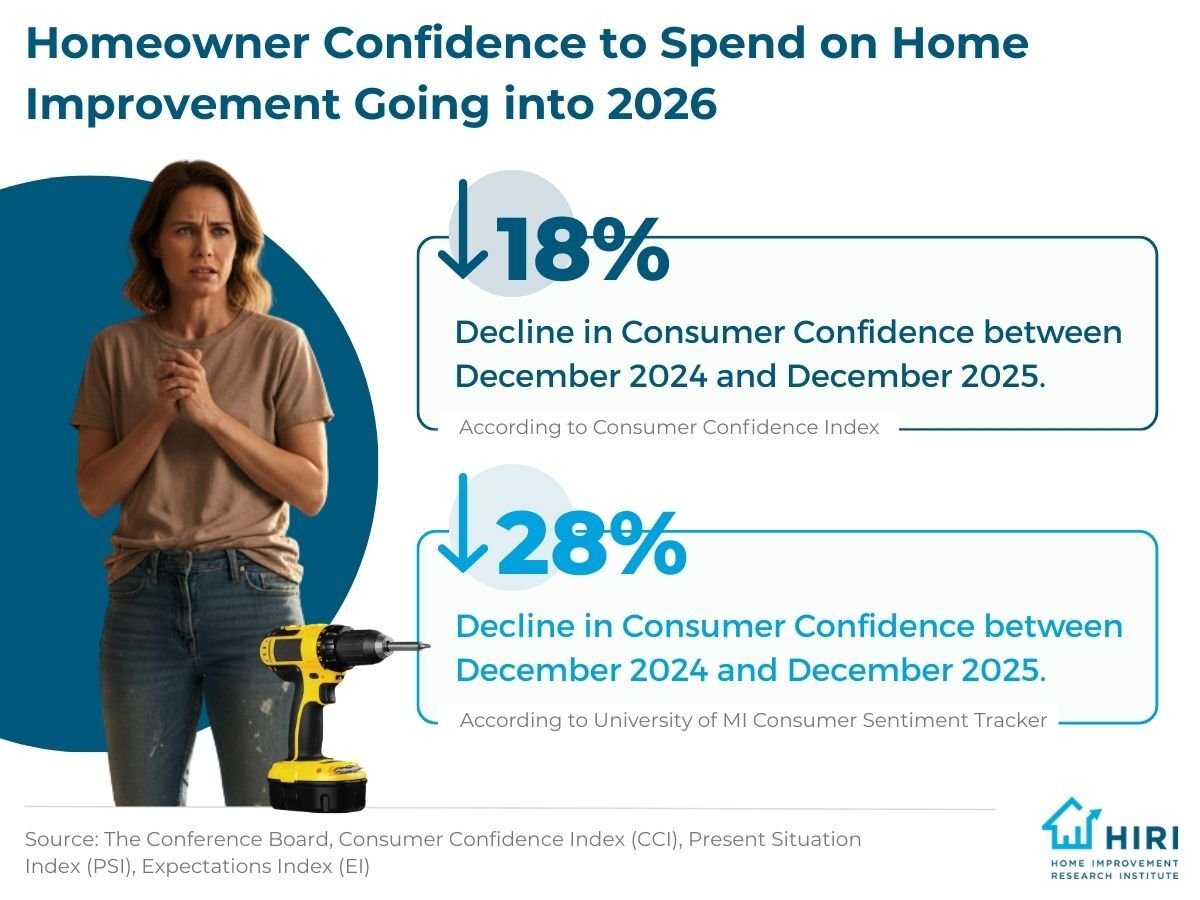
The Consumer Confidence Index (CCI) decreased 4.1% between November and December 2025 and was down more than 18% compared to last year. The consumer sentiment tracker, from the University of Michigan, reveals a similar story, dropping more than 28% from December 2024 to December 2025.
Disposable Income Among Homeowners in 2026
Real disposable personal income (RDPI) grew slightly from the start of 2025 through the third quarter, with year-over-year RDPI up about 1.5% from September 2024 to September 2025, based on data from the U.S Bureau of Economic Analysis. However, advanced retail sales for building materials, garden equipment and supplies dealers were down more than 5% in the fall of 2025 compared to the same period last year.
Housing Market Trends in the U.S. in 2026
In terms of the housing market, homeownership rates have been mostly steady since 2021, reaching their lowest point of the past five years during the first and second quarters of 2025, with slight growth in the third quarter. The Midwest saw the largest decrease from last year, with the northeast seeing a slight increase. Building permits and single-family home starts both ended the year down compared to last year.
Housing completions were also down compared to last year in all regions except the south.
Mortgage rates—which were incredibly volatile for a while—have started to balance out the past couple of years. According to Freddie Mac, the 30-year and 15-year mortgage rates remained steady in December. Compared to last year, both are down only fractionally.
Aging Housing Industry in the U.S.
Across the U.S., the housing inventory is aging, with the Northeast and Midwest possessing the oldest homes in the country. According to the National Association of Home Builders (NAHB), almost half of the owner-occupied homes in the U.S. were built before 1980 and have a median age of 41 years. As individuals stay in their houses longer, not only are maintenance and repairs a necessity, but they also may be looking for ways to update their properties to ensure they stay comfortable and functional in light of changing lifestyles.
Household Income and Employment
Our Project Decision Study shows that home improvement project participation skews toward full-time employed households, with major renovations drawing the most economically active owners. Retired homeowners are typically the second-most represented demographic when it comes who is pursuing home renovations. However, that distinction is significantly less for major renovations, as well as interior finishes.
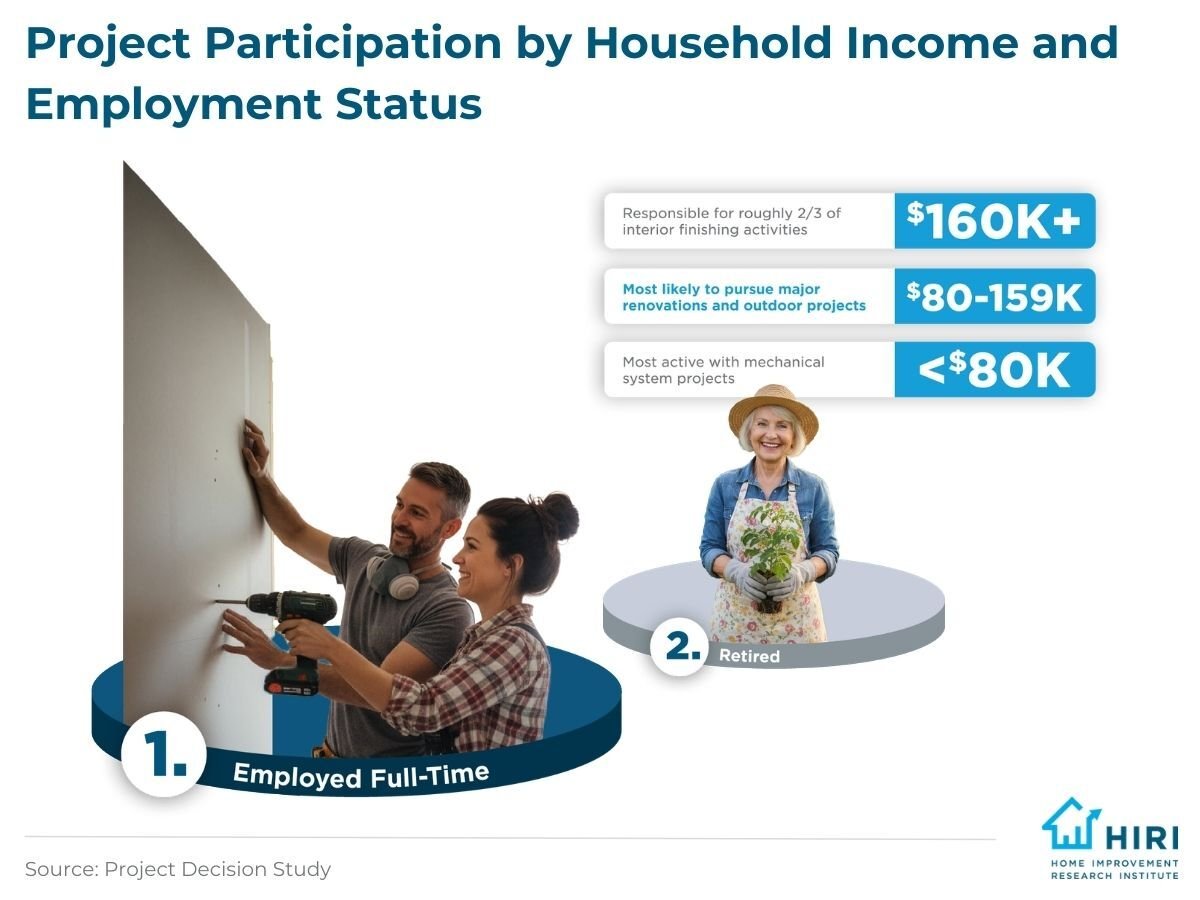
Household income also factors into project participation. About two-thirds of interior finishing activities are done by households bringing in $160,000-plus. Medium-income households ($80,000 to $159,000) are the most likely to pursue major renovations and outdoor projects, while those households making less than $80,000 are the most active with mechanical system projects.
Where Do Homeowners Invest the Most into Home Improvement Activities?
Based on data from HIRI's 2025 Project Decision Study, across all project types, homeowners had spent an average of about $21,000 in the past 12 months, with the median total home improvement spending hovering about $11,500.
Exterior Projects Make Up Largest Percentage of Home Improvement Activity
Major renovations dominate high-end projects—or those in the $50,000-plus range—while approximately half of yard and interior projects fall on the lower end, about $5,000 to $9,999 range. Because of their scale and scope, major renovations are less frequently pursued by homeowners.
Meanwhile, exterior projects are the most popular type of large-scale home improvement activity undertaken by homeowners, followed by interior projects. Notably, major renovations do not result in an outsized pro share because higher dollar spend is spread across materials and soft costs rather than labor. Exterior envelopes are where we see the highest percentage of the total cost going toward paid contractors.
Increasing Comfort, Livability and Resale Value are Key Drivers for Home Improvement
When it comes to project motivations, improving comfort and livability is the main driver across all project categories. However, taking a closer look, different types of projects are pursued based on different motivations:
-
Increasing functionality pertains more to major renovations
-
Aesthetic considerations and enhancing value are more relevant to interior finishes
-
Improving energy efficiency is most relevant to mechanical system maintenance and upgrades
Material purchasing is primarily led by homeowners, with contractors more active in select categories, such as mechanical systems and exterior finishes, which involve more technical complexity and reflect an emphasis on warranties, efficiency, and code compliance. Major renovations attract more advanced DIY homeowners, while interior and exterior projects skew toward intermediate experience.
Perceived resale recovery is strongest for major renovations, with more than half believing they would see anywhere from an 80% to 100% return on investment (ROI). Most other projects cluster around partial, not full, payback, with the perceived resale recovery lowest for exterior envelope and yard, garden, and other outdoor improvements.
Is Home Improvement Spending Changing Among Homeowners?
While overall home improvement spending declined at the end of 2025, based on data from our Quarterly Homeowner Project Activity Tracker, fewer completed projects led to higher spend per project, which implies tighter prioritization and deeper investment in essential or higher-value work. Intentions around home improvement spending seem to be steady as we kick off 2026, signaling a measured and cautious outlook rather than retrenchment, with homeowners maintaining intent while calibrating budgets and project scope.
-
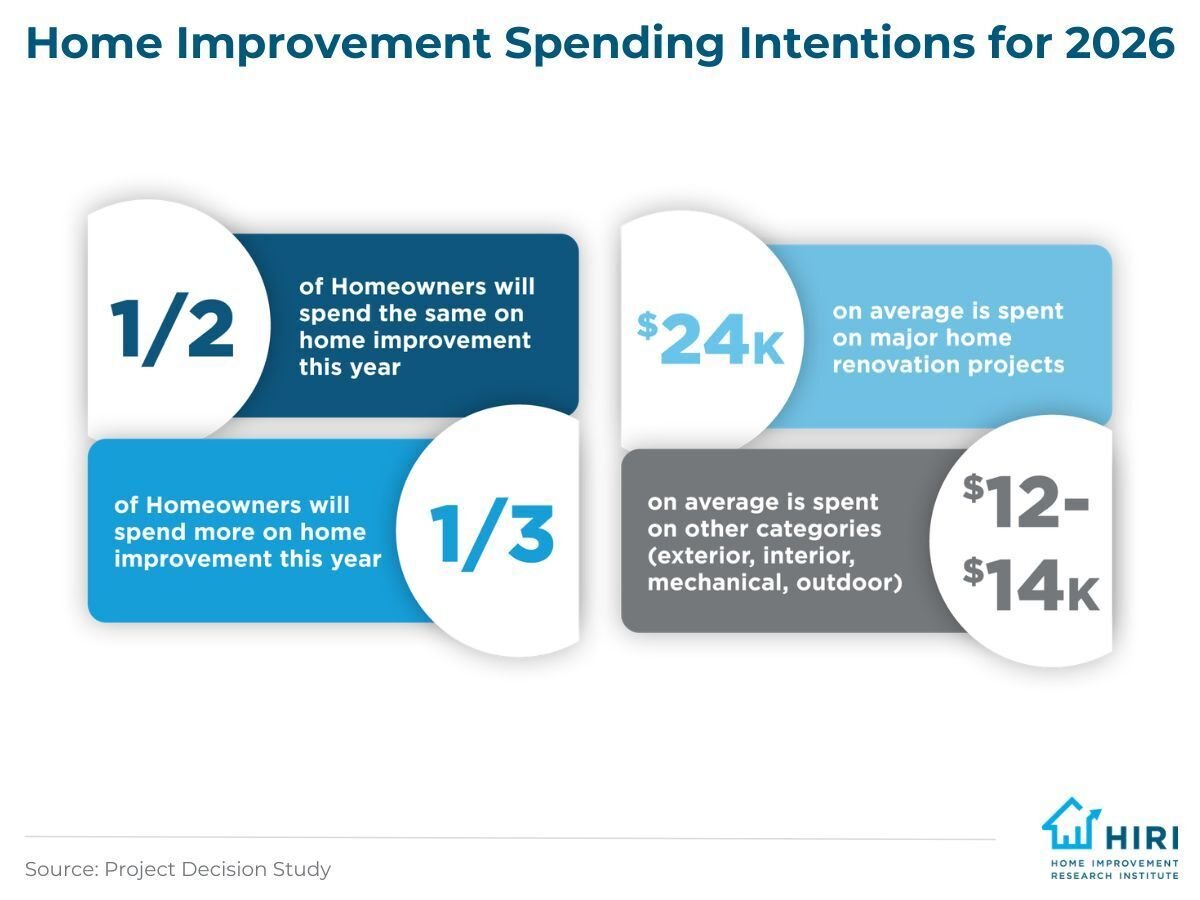
About half of homeowners expect to spend roughly the same amount on home improvement in the next year as they did in the year prior.
-
Another one-third expect they will spend more on home improvement in 2026 than in 2025.
Financial conditions for U.S. homeowners held largely steady throughout 2025 – with income, cash, discretionary capacity, and debt showing limited change across households. Maintenance and necessary repairs remain the primary drivers for home improvement activities, with other motivations including improving comfort and aesthetics, enhancing safety and security, and increasing functionality.
What Expectations Surround Home Improvement Spending in 2026?
Looking ahead, maintenance continues to dominate near-term home improvement plans for property owners.
-
About half are planning to do a maintenance project in the first quarter of 2026.
-
Another 30% are planning a home repair.
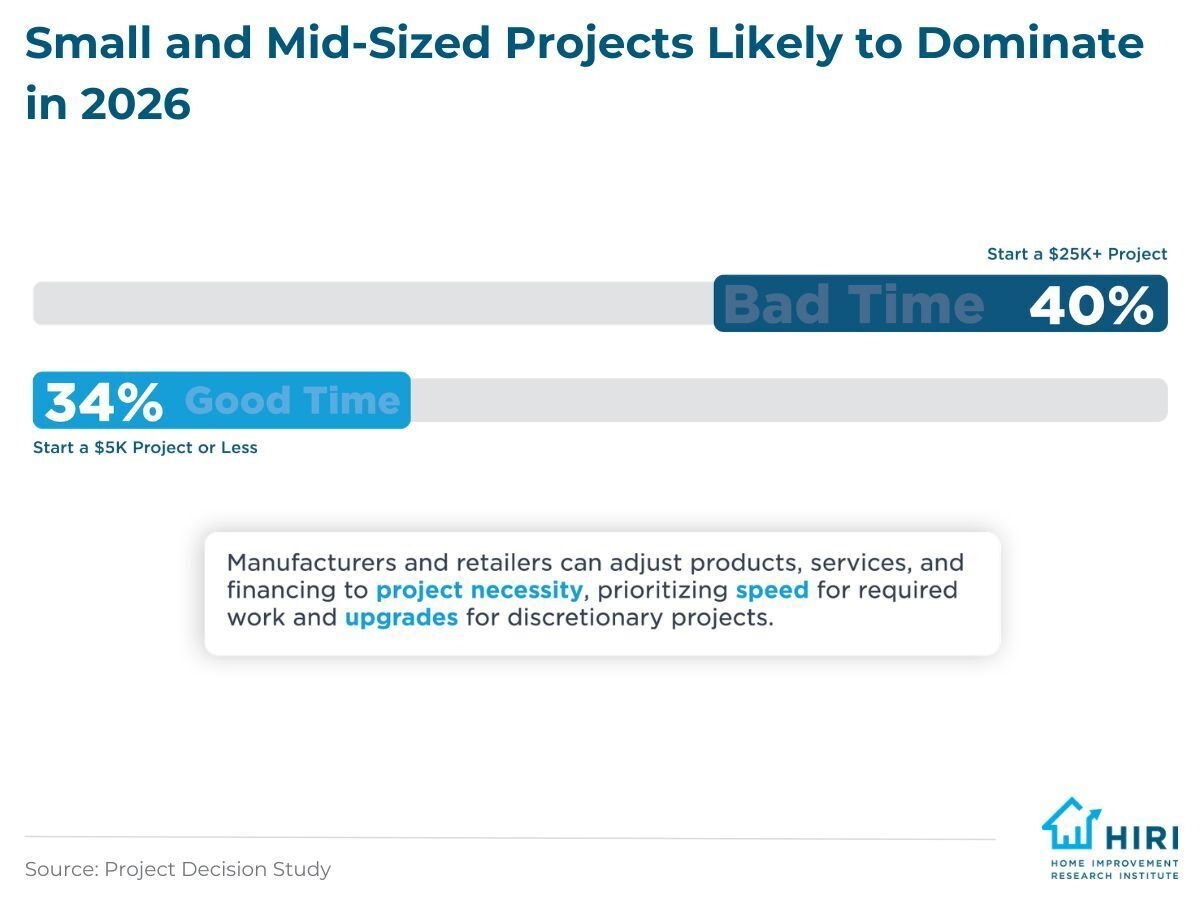
Both reflect a fairly steady trend in project intention. While 40% of homeowners feel it’s a bad time to start a large project, in the $25,000-plus range, they are feeling generally more optimistic about mid-sized and smaller projects, with about one third believing it’s a good time to start a project in the $5,000 or less range.
Based on HIRI's Homeowner Project Activity Tracker, nearly four out of five homeowners were planning an interior project in the next 12 months. Exterior envelope projects and yard, garden, or outdoor projects are also on the docket for about two-thirds of homeowners, while only a third plan to do a mechanical system project. In quarter four of 2025, planned spending declined to its lowest point of the year, with homeowners anticipating to spend an average of about $3,100 on home improvement over the next 12 months.
According to our 2025 Project Decision Study, big box retailers – such as Home Depot, Lowe’s and Menards – remain the dominant purchasing channel for project materials, although specialty suppliers are used for about one-third of projects involving interior finishes and mechanical systems.
In-store pickup also continues to be the prominent purchase and delivery method. The one exception is for mechanical materials and supplies, where online purchasing with direct delivery to the homeowner, is the most common method. Project decisions concentrate in spring, with yard projects peaking earlier in year, in conjunction with nicer weather, while interior finishes are most common in January, February and March.
Stay on Top of Changes in Customer Sentiments and Behaviors
Our most recent Project Decision Study offers a comprehensive look at customer behaviors and sentiments on projects and spending, particularly surrounding mid- to large-sized projects in the following categories: major renovations, exterior envelope, mechanical systems, interior finish, and yard, garden, and outdoor projects.
To dig deeper into the numbers and plan for the coming year, become a member of the Home Improvement Research Institute and get instant access to our full data sets. Our wealth of industrywide research into consumer behaviors, sentiments and activities will help stretch your market research dollars and supplement your company's internal reports and custom market research to give you more insights and confidence in your strategic decision-making.