
Measure how much consumers value “Made in America” labels when purchasing home improvement products relative to other countries.
Edit
Edit
Made In America Study & Impact Analysis
As interest in supporting domestic manufacturing continues to grow, understanding how consumers perceive and value “Made in America” products has never been more important. The Home Improvement Research Institute’s Made in America Study explores how shoppers evaluate American-made home improvement products versus imported goods, the factors driving their purchase decisions, and the impact of economic conditions such as tariffs on these preferences. This research provides manufacturers, retailers, and marketers with valuable insights into consumer behavior, brand trust, and the evolving significance of domestic production in the home improvement market.
Objectives
Compare perceptions of quality, brand reputation, and trust for American-made versus imported products.
Conduct conjoint analysis to assess willingness to pay for domestically produced goods vs. other countries and under what conditions.
Evaluate the consumer impact of tariffs on Made in America preference.
Segment homeowners based on attitudinal characteristics to uncover distinct profiles and decision-making patterns.
Past Iterations
FAQs
How important is 'Made in America' labeling to home improvement shoppers?
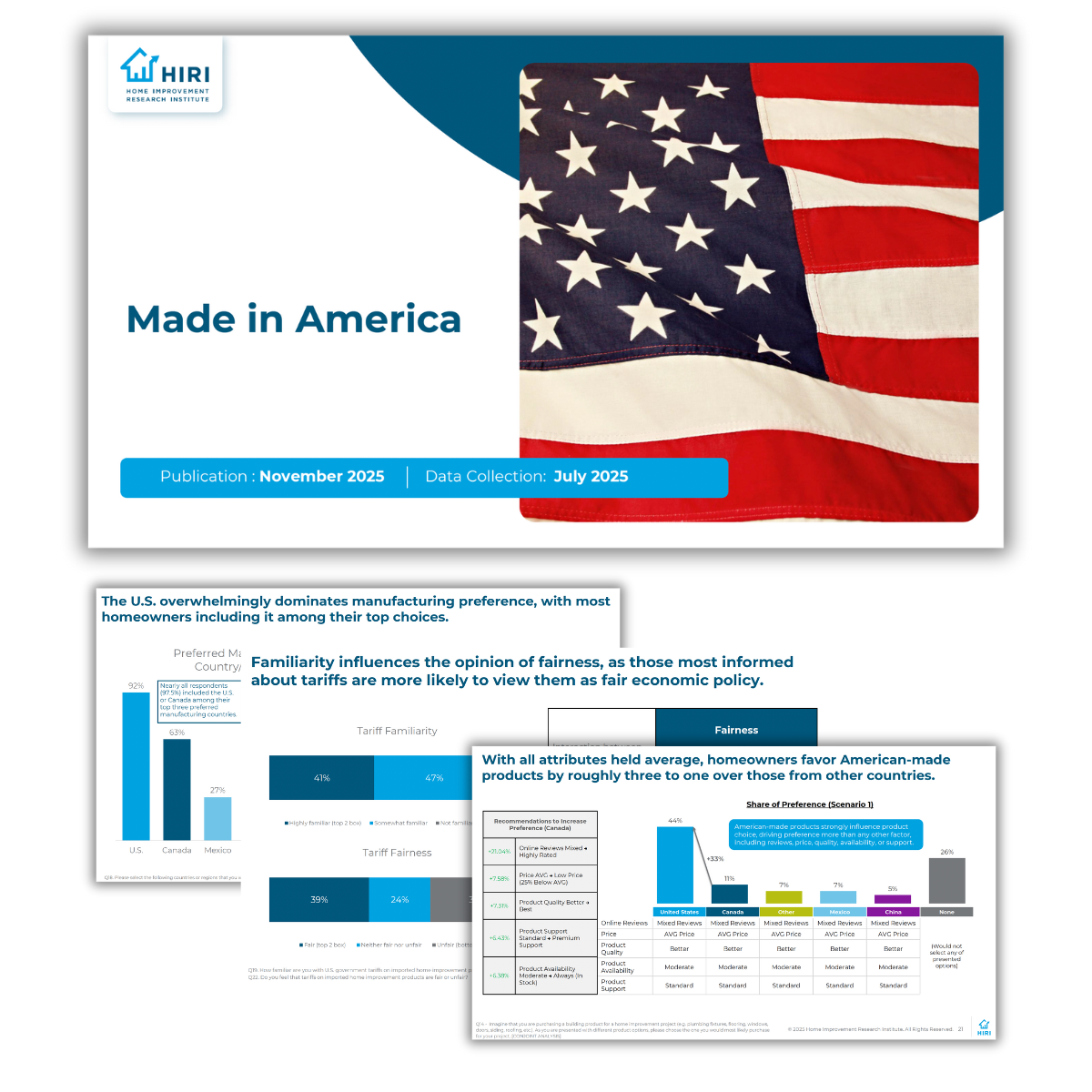
“Made in America” influences home improvement choices but trails price and quality, carrying about 40% of price’s weight, according to the Home Improvement Research Institute's Made in America Study.
The preference is broad yet largely ideological, strongest among conservatives and older homeowners, and reinforced by hands-on, experience-driven buyers. Advanced DIYers and urban homeowners show the highest intensity of support for American-made products.
HIRI's study identifies three distinct segments emerge in how homeowners perceive and respond to trade and manufacturing dynamics: Continental Preference, American Proud, and Global Pragmatists. These segments demonstrate varying attitudes when it comes to how important the "Made in America" label is when shopping for home improvement products.
For example, Continental Preference buyers lean pragmatic, favoring U.S. and Canadian products but guided chiefly by price and value, while American Proud consumers are the most tariff-literate and supportive of trade protection, viewing American-made goods as both higher quality and worth a premium.
What motivates homeowners to buy Made in America brands for home improvement?
Confidence in American-made products is nearly universal, strengthened by hands-on experience and familiarity. Preference for American-made products is not grounded in price but anchored to trust in manufacturer support, reputation, and quality, based on findings from the Home Improvement Research Institute's Made in America Study.
Those who value American-made also perceive higher quality, reinforcing belief through experience. Performance and reliability drive perceptions most, though price awareness grows with age. American-made products dominate when attributes are equal, holding roughly a three-to-one advantage over imports. Yet this advantage can narrow meaningfully.
Canadian products reach near parity by improving online reputation and perceived quality, while Mexican options approach similar levels by enhancing reputation, price, and availability
Do younger homeowners care about buying American-made home improvement products?
Younger homeowners demonstrate a more intense interest in buying American-made home improvement products than older homeowners. Purchasing "Made in America" products is considered "highly important" to about 54% of Millennial/Gen Z homeowners compared to 42% of Baby Boomers and Silent Generation homeowners, according to data from the Home Improvement Research Institute's Made in America Study. Additionally, buying American-made products is "highly important" 44% of Gen X homeowners. However, about the same percentage of each age group finds buying American-made home improvement products "not important," while the rest fall into the "somewhat important" category.
Skilled DIYers and men associate U.S. manufacturing with superior craftsmanship and reliability, while younger and female homeowners anticipate higher prices than other countries but still trust North American quality. Additionally, younger and female homeowners expect higher prices on American-Made, seasoned, whereas male buyers see narrower gaps, reflecting trust built over time.
Which home improvement categories are most likely to be Made in America?
Some of the home improvement categories most likely to be Made in America include major appliances, kitchen cabinets and countertops, flooring and siding, paint and interior finishes, and pavers and outdoor surfaces. Building product categories rely on brand reputation, domestic manufacturing strength, and significant consumer preference to be notably competitive against imported goods.
The Home Improvement Research Institute's Made in America Study includes data on the perceptions of quality, brand reputation, and trust for American-made versus imported products. Additionally, the report segments homeowners based on attitudinal characteristics to uncover distinct profiles and decision-making patterns when it comes "Made in America" preferences.
Do most contractors choose Made in America products when remodeling homes?
Most contractors do not necessarily default to choosing “Made in America” products when remodeling homes, but there is an increasing trend toward specifying them within certain contexts. For example, they may want to comply with specific state incentives or green building certification requirements.
Additionally, the Home Improvement Research Institute's Made in America Study found that a significant number of homeowners value the “Made in America” label, with about one in three considering it an important factor when buying home improvement products, though price still carries more weight. This means that consumer preference can influence contractors to choose Made in America products when remodeling homes.
However, there are also practical considerations that contractors have to make, and certain common building products and materials (including lighting, hardware, plumbing fixtures, and electrical supplies) are still overwhelmingly important at more cost-effective rates.
Do contractors recommend American-made products to their clients?
Contractors may recommend American‑made products to their home improvement clients for a variety of reasons that align with project goals, including compliance with federal regulations, cost control, and supply chain resilience. They may also want faster and better support from domestic manufacturers. Additionally, contractors may be swayed by the opinions and preferences of their clients, and whether the latter have strong opinions about American-made products and materials.
The Home Improvement Research Institute's Made in America Study measures how much consumers value “Made in America” labels when purchasing home improvement products relative to other countries. This data-driven report also compared compares perceptions of quality, brand reputation, and trust for American-made versus imported products.
How does Made in America influence purchasing decisions for kitchen remodels?
There is a strong domestic manufacturing base for several building product categories that might be used for kitchen remodels, including cabinets, countertops, flooring, paint, and kitchen appliances and equipment. The presence of strong and competitive brands on the market may influence homeowners and contractors to choose "Made in America" products for kitchen remodels and renovations.
The Home Improvement Research Institute's Made in America Study explores how much consumers value “Made in America” labels when purchasing home improvement products, relative to items imported from other countries. The study also compares perceptions of quality, brand reputation, and trust for American-made versus imported products.
The data reveals that both personal values and direct experience shape perceptions of American craftsmanship and reliability.
Are there statistics on consumers choosing U.S.-made home improvement products?
The “Made in America” labels influences home improvement choices but trails price and quality, carrying about 40% of price’s weight. Interest in U.S.-made home improvement products spans demographics but is driven more by ideology than age or income. Political orientation explains most variation, reflecting a preference rooted in worldview rather than affluence or life stage.
The Home Improvement Research Institute's Made in America Study provides a wealth of statistics on consumers choosing U.S.-made home improvement products. The report explores how shoppers evaluate American-made home improvement products versus imported goods, the factors driving their purchase decisions, and the impact of economic conditions such as tariffs on these preferences.
Edit
Related Reports
Not a Member Yet?
Explore free articles, infographics, and webinars to get even more value from HIRI
Infographic
Key Homeowner and Contractor Trends in Q1 2026
Home improvement activity has been off to a slower start in 2026, with...
Infographic
What’s Driving Home Improvement Spending in 2026?
Despite a continued level of financial strain and tempered customer co...
Webinar
HIRI Home Improvement Industry & Recent Research Update - November 2026
Join HIRI Executive Director Dave King for a timely update on the late...
Fast Fact
Homeowners who finance spend nearly 3 times more per project than those who don't, $12,500 versus $4,250, despite having lower net worth.
Financed and non-financed homeowners report the same median household ...

Enter a valid email address
There was an error
Thanks for subscribing!
© 2026 Home Improvement Research Institute. All rights reserved.