
Determine medium- to large-sized home improvement project activity completed in the last 12 months, including total spending and financing methods.
Edit
2025 Home Improvement Project Trends
Biennial Homeowner Project Decision Study & Analysis
The home improvement market continues to show long-term resilience as project activity stabilizes from recent highs. While overall spending has moderated, homeowner engagement, especially for mid- to large-scale projects, remains strong and above historical norms.
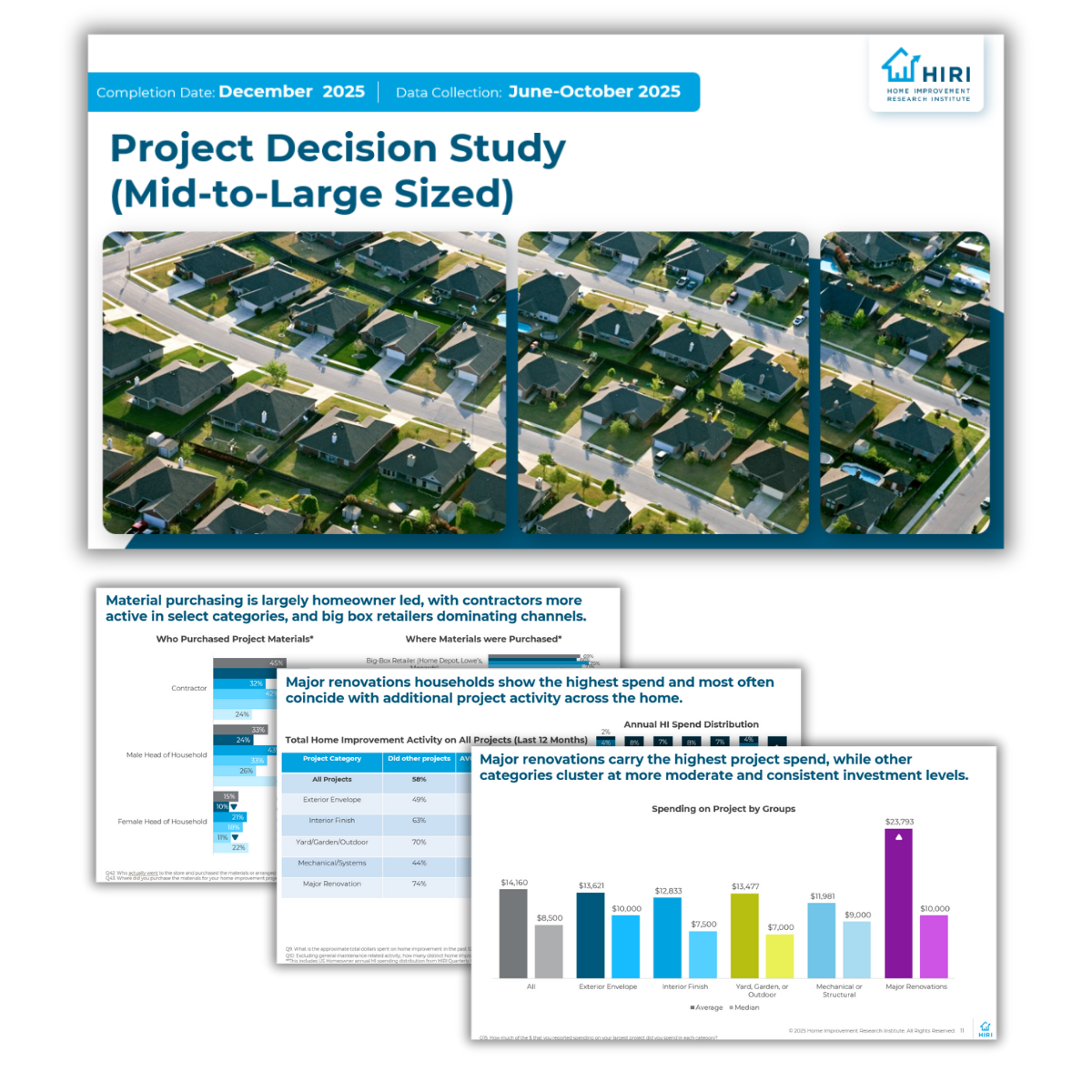
HIRI’s 2025 Project Decision Study delivers trusted insight into how homeowners plan, fund, and execute home improvement projects. Covering 47 project categories with a focus on projects $5,000 and above, the study provides actionable intelligence to support strategic planning, product development, and go-to-market decisions.
See detailed reports covering the following project areas: Exterior Envelope, Interior Finish, Major Renovations, Mechanical Systems, and Yard, Garden and Outdoors.
Objectives
Analyze completion methods, homeowner satisfaction, motivations, and factors influencing project delays.
Identify key influences and resources used in selecting and managing projects, professionals, and materials, as well as product purchasing channels used.
Explore project planning timelines, from idea inception to project completion.
Analyze demographic and household factors influencing home improvement projects.
Download Report Overview
Download Exterior Envelope Specific Report
Download Interior Finish Specific Report
Download Major Renovations Specific Report
Download Mechanical Systems Specific Report
Download Yard, Garden, and Outdoors Specific Report
Past Iterations
FAQs
What are the latest market trends in home renovation that I should be aware of?
The home improvement market continues to show long-term resilience as project activity stabilizes from recent highs. While overall spending has moderated, homeowner engagement, especially for mid- to large-scale projects, remains strong and above historical norms, based on findings in the Home Improvement Research Institute's biennial Project Decision Study.
Home improvement participation skews toward long-term, single-family homeowners, with distinct profiles by project type. Exterior projects reflect maintenance among older, tenured owners, while interior and major renovations concentrate among higher income, higher equity households pursuing discretionary upgrades.
Although they are done the least frequently, major renovations carry the highest project spend, while other categories cluster at more moderate and consistent investment levels. Maintenance is the main driver for a majority of exterior projects, or about two-thirds. Interior work reflects comfort and aesthetics, while energy efficiency defines mechanical investments.
What data and resources exist to help me track project initiation and planning rates for home renovations?
Measuring the planning rates of home improvement projects involves tracking a variety of factors that give insight into early stages of homeowner intent and project initiation. This includes research activity, contractor engagement, budget creation, and project design, for example. From there, you can analyze how effectively the project planning translates into project execution, and what the timeline looks like from idea to completion.
Based on the Home Improvement Research Institute's biennial Project Decision Study, home improvement activity follows a consistent seasonal arc, but timelines diverge meaningfully by project type. Mechanical work advances fastest, exterior projects align with weather, while major renovations unfold far longer, driven by extended planning and execution. HIRI's study is a useful resource for tracking how often home projects are initiated, and when. You can use the data in the study to explore project planning timelines, from idea inception to project completion.
What factors should I consider when analyzing homeowner buying patterns for kitchen renovations?
When analyzing homeowner buying patterns for kitchen renovations, it's important to note that kitchen projects demand the most time, information, and professional input. Kitchen projects tend to have the highest average and median spend among interior home improvement projects, based on data from the Home Improvement Research Institute's biennial Project Decision Study.
Project costs are generally split evenly between paid contractors and purchasing materials and products for the project. Another factor to consider is that kitchen projects show moderate overlap with other interior improvement activities, particularly flooring and painting. Some of the products that homeowners most frequently buy for their kitchen renovations include cabinets, countertops, interior paint, flooring, and finished electrical/lighting. A majority, or roughly two-thirds, of kitchen renovations are paid for with cash, while less than one-fifth are paid for with credit cards.
What projects are covered in HIRI's research?
The Home Improvement Research Institute's 2025 Project Decision Study covers 47 project categories, with a focus on projects $5k and above. These projects are broken into five overarching categories: Exterior Envelope, Interior Finish, Major Renovations, Mechanical Systems, and Yard, Garden and Outdoors.
HIRI offers detailed reports on each of these five project areas, zeroing in on wide range of specific projects, including windows, decks, exterior and interior doors, flooring, kitchen and bath renovations, interior and exterior painting, garage remodels, accessory dwelling unit (ADU) additions, whole home remodels, electrical wiring, energy management, septic systems, HVAC, solar panels and storage, home automation and security, driveway, fencing, outdoor lighting, walkways, retaining walls, patios, and more.
This data-rich report is helpful in analyzing medium- to large-sized home improvement project activity completed in the last 12 months, including total spending and financing methods, as well as looking ahead to upcoming plans for various home improvement projects. You may also find value in analyzing this information alongside HIRI's most current Quarterly Home Improvement Activity Tracker results.
What factors should I consider when analyzing homeowner buying patterns for bathroom renovations?
Homeowners report strong satisfaction, modest delays, limited regrets, and solid expected resale recovery, especially for kitchens, baths, and other interior remodels. Spending is elevated for bathroom projects, because of the scope and complexity, according to the Home Improvement Research Institute's biennial Project Decision Study.
For bathroom renovations, almost two-thirds of project costs go toward labor and only a third go toward materials and products for the project. In terms of homeowners' buying patterns for bathroom renovations, the products most frequently purchased for these projects include finished plumbing, flooring, interior paint, and cabinets. A majority, or roughly two-thirds, of bathroom renovations are paid for with cash, while less than one-fifth are paid for with credit cards.
Are homeowners more likely to renovate kitchens or bathrooms?
Both kitchen and bathroom renovations are top types of interior home improvements. According to the Home Improvement Research Institute's 2025 Project Decision Study, homeowners are slightly more likely to renovate their kitchen, at least when it comes to larger projects. Among large interior projects, kitchen renovations have the highest rate of being completed using a combination of DIY labor and paid contractors. The main drivers of kitchen renovations include improving aesthetics/style, improving comfort/livability, increasing home value, and increasing functionality. Energy efficiency also plays a larger role in influencing kitchen renovations than most interior projects.
What are the most common home improvement projects for new homeowners?
Some of the most common home improvement projects for new homeowners include interior/exterior painting, flooring replacements, landscaping, and other cosmetic upgrades. However, there are variations based on the age and state of the residence and what the new homeowners are looking for.
The Home Improvement Research Institute's 2025 Project Decision Study is an in-depth look at how homeowners plan, fund, and execute home improvement projects. The report covers 47 project categories, with a focus on projects $5,000-plus, providing insight on completion methods, homeowner satisfaction, motivations, and factors influencing project delays, as well as the key influences and resources used in selecting and managing projects, professionals, and materials, as well as product purchasing channels used.
Edit
Related Reports
Not a Member Yet?
Explore free articles, infographics, and webinars to get even more value from HIRI
Infographic
Key Homeowner and Contractor Trends in Q1 2026
Home improvement activity has been off to a slower start in 2026, with...
Infographic
What’s Driving Home Improvement Spending in 2026?
Despite a continued level of financial strain and tempered customer co...
Webinar
HIRI Home Improvement Industry & Recent Research Update - November 2026
Join HIRI Executive Director Dave King for a timely update on the late...
Fast Fact
Homeowners who finance spend nearly 3 times more per project than those who don't, $12,500 versus $4,250, despite having lower net worth.
Financed and non-financed homeowners report the same median household ...

Enter a valid email address
There was an error
Thanks for subscribing!
© 2026 Home Improvement Research Institute. All rights reserved.